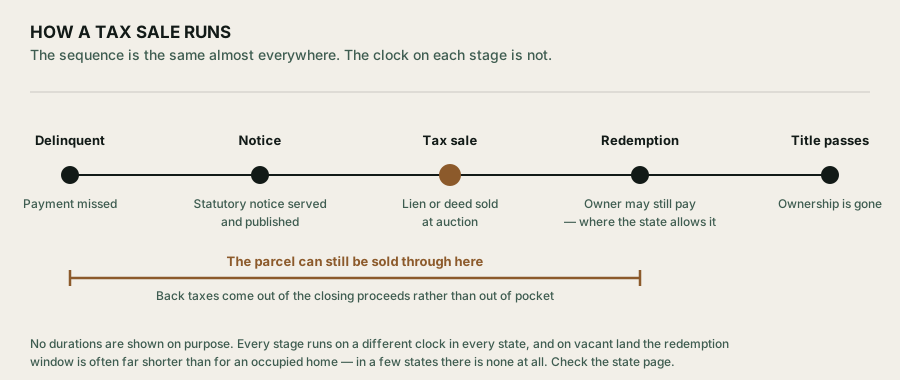
When a county sells your land at a tax auction for more than the delinquent taxes, penalties, interest, and sale costs owed, the difference is called surplus or excess funds, and it legally belongs to you, the former owner, not the county. Recovering it means filing a claim, sometimes in court, before a state-specific deadline passes and the money escheats.
What Are Surplus Funds From a Tax Sale?
Surplus funds are the amount a tax auction’s winning bid exceeds what the property owed in back taxes, interest, penalties, and administrative costs, and by law that leftover money still belongs to whoever held title or a recorded lien on the land before the sale. A county cannot simply keep it because the auction happened to draw a higher bid than the tax bill required.
This is not just custom. In May 2023 the U.S. Supreme Court ruled 9-0 in Tyler v. Hennepin County that a government violates the Fifth Amendment when it keeps more than it is owed from a forced tax sale. According to Cornell Law School’s Legal Information Institute, the case involved a Minnesota county that sold a $40,000 condominium to satisfy roughly $15,000 in unpaid taxes and kept the remaining amount for itself; the Court treated that as a taking of private property, not a tax collection. Since then, states have had to make sure former owners have some real path to the surplus once a county forces a tax deed sale, even though the mechanics still differ sharply from one state, and often one county, to the next.
Surplus can arise from either kind of forced sale a county runs. In tax deed states, the county auctions the property itself, and any bid above the delinquent tax bill is the surplus. In tax lien states, the county first sells a certificate against the debt rather than the land; if the certificate holder eventually forecloses and forces a sale, the same math applies once that sale closes; whatever the winning bid raises above the certificate amount, accrued interest, and costs still belongs to the former owner or lienholders, not the certificate holder who forced the sale.
Who Is Entitled to Claim the Money?
The former owner of record almost always has a right to claim surplus funds, but state law typically pays off anyone else with a recorded financial interest in the property first, including mortgage holders, judgment creditors, and other lienholders whose collateral the tax sale wiped out without paying their debt.
California illustrates the strict version of that rule: the county must first pay any lienholder recorded before the tax deed, in order of lien priority, and only then the person who held title before the sale, according to California Revenue and Taxation Code § 4675. Georgia takes a looser approach and lets the record owner, any security-deed holder, and any other party with a recorded interest all file at once; according to the Gwinnett County Tax Commissioner, when more than one party claims the same funds, a judge decides who gets paid rather than a fixed statutory order. Georgia’s excess-funds process runs alongside its own redemption timeline, which we cover in Georgia’s redeemable tax deed system. If the former owner has since died, heirs or the estate generally step into that same claim, but only after producing probate paperwork showing who is legally entitled to act.
Ownership that was ever split among more than one person adds another layer. If the land was held by co-owners, or passed down as heirs property with several relatives sharing an undivided interest, most counties expect every owner of record, or their respective heirs, to be identified before releasing funds, and a single co-owner usually cannot collect the full amount alone. That is one of the more common reasons a claim that looks simple on paper takes months to resolve: the county is not being slow on purpose, it is waiting on paperwork establishing who among several possible claimants actually owns what share.
How Do You Actually File a Claim?
Counties handle surplus-fund claims one of two ways: as a straightforward administrative claim filed with the tax collector, treasurer, or tax commissioner, or as a formal petition filed in the court that handled the tax sale, and which one applies depends entirely on state law.
Texas requires the court route. A claimant must file a petition in the same court that ordered the tax sale before the second anniversary of the sale date, and serve every other party to the original case at least 20 days before any hearing, according to Texas Tax Code § 34.04 and the Texas State Law Library’s foreclosure guide. Nevada’s Clark County works the opposite way: a claimant submits an application and supporting documents directly to the treasurer’s office, no lawsuit required, according to the Clark County Treasurer. Most states fall somewhere in that range, an administrative claim that only escalates to a judge if two or more people claim the same money.
What Documents Will the County Ask For?
Most counties will not release surplus funds without documentary proof that you are who you say you are and that you actually held an interest in the property before the sale, and the paperwork gets heavier if the original owner has since died.
A typical claim packet includes:
- A government-issued photo ID
- A completed IRS Form W-9, since the payout is reportable income
- Proof of former ownership, such as a certified copy of the deed or property tax records
- A notarized claim, affidavit, or release-of-funds form supplied by the county
- If the owner has died: a death certificate plus either probate court letters of administration or a notarized affidavit of heirship
- If your legal name has changed: a marriage certificate or court order connecting the old and new name
That list reflects the Clark County Treasurer’s claim instructions, but nearly every county asks for the same basic categories: identity, ownership, and, where applicable, inheritance.
Claims most often stall, or get rejected outright, over small mismatches rather than missing money: a name on the ID that does not exactly match the name on the deed, a claim form that is unsigned or not notarized, or an address for a lienholder that is years out of date. Reading the specific county’s instructions before mailing anything, rather than assuming one state’s checklist applies everywhere, saves a second round trip.
How Long Do You Have Before the Deadline Passes?
Deadlines to claim surplus funds range from about a year in some states to two years or more in others, and in at least one state you have to act before the auction happens, not after, so the safest assumption is that a clock is already running the moment the property sells.
| State (example) | Deadline | Measured from | Source |
|---|---|---|---|
| Texas | 2 years | Date of the tax sale | Texas Tax Code § 34.04 |
| California | 1 year | Recordation of the tax collector’s deed | Cal. Rev. & Tax Code § 4675 |
| Nevada (Clark County) | 1 year | Date the deed is recorded | Clark County Treasurer |
| Michigan | Before the sale | Notice of intent due by the statutory deadline after the foreclosure judgment, before the county sells the property | MCL 211.78t, via Legal Services of Eastern Michigan |
These four examples do not cover every state, and even within a state, individual counties sometimes apply the rule differently in practice. Florida’s window, for one, can run out in months rather than years, a pattern we cover in Florida’s tax deed auction process. Call the tax office in the county where the land sat before assuming any deadline above applies to your situation, and do it as soon as you learn the sale happened rather than waiting for a notice that may never arrive.
What Happens to Money Nobody Claims?
If no one files a valid claim before the deadline, the surplus does not just disappear. Most states require the county to turn it over to a state unclaimed-property or treasury division, where it sits on the state’s books, sometimes indefinitely, waiting for the rightful owner or an heir to come forward.
New Jersey’s unclaimed-property division, for example, holds escheated funds in its Unclaimed Property Trust Fund until a valid claim is processed, and the reported owner “never relinquishes ownership,” according to the New Jersey Department of the Treasury. The state becomes a custodian, not a new owner, in that model. Other states instead sweep unclaimed county-level surplus into the county’s own general fund after a set period, which can make the money considerably harder to trace and recover than a listing on a searchable state unclaimed-property database. Either way, the longer you wait, the more paperwork it takes to prove the claim, and the harder county or state staff have to work to figure out who you are.
How Do You Avoid Being Overcharged to Recover Your Own Money?
Because surplus-fund lists are public record, a cottage industry of finder and recovery services routinely contacts former owners and offers to locate and collect the money for a cut, sometimes a large share of the total, and counties are increasingly warning claimants that no middleman is required.
The Gwinnett County Tax Commissioner tells claimants directly that “you are not required to pay, or be represented by, any third party in order to claim excess funds.” Claim forms, instructions, and contact information are public and free from the tax office itself. If a recovery service contacts you before you knew the funds existed, verify the amount and process directly with the county before signing anything that assigns away a percentage of a claim you could file yourself for free.
Where Do You Start Looking?
Start with the tax collector, treasurer, or tax commissioner in the county where the land was located, since surplus funds are held and disbursed at the county level in nearly every state before any escheat to the state ever happens.
- Ask the county’s tax office, not the tax deed buyer, whether an excess-funds or surplus-funds list exists and whether your parcel appears on it.
- Request the specific claim form and confirm the deadline and required documents for that county; do not assume the table above applies without checking.
- If the deadline has already passed, check your state’s unclaimed-property database, since that is typically where escheated funds land next.
- If the original owner has died, start the probate or heirship paperwork early, since it is usually the slowest part of any claim.
This guide is part of a broader collection on selling problem land. If the reason you are reading this is that a different parcel you still own is now behind on its own property taxes, letting that one reach auction too is the outcome worth avoiding before its own redemption period runs out. AMM Land Sales makes cash offers on land with delinquent taxes owed and settles those taxes out of closing proceeds rather than requiring you to pay them first, an option covered in our guide to selling land with back taxes. It will not get you money already owed to you from a past sale, but it can keep the next parcel from ending up in the same position.