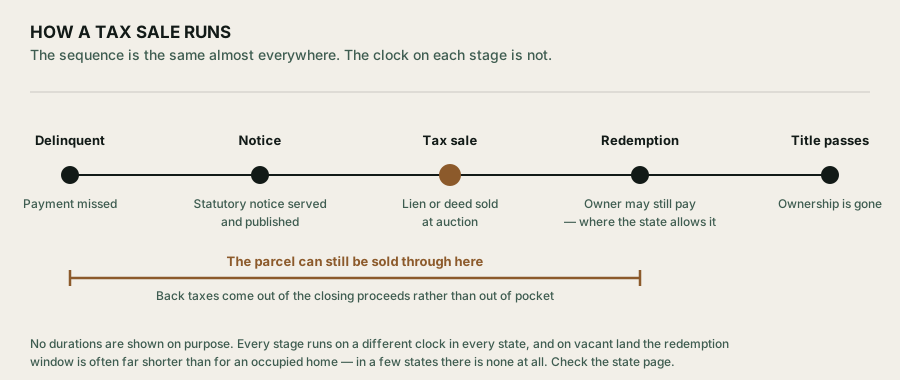
Florida sells tax-delinquent land administratively: a private certificate holder applies for a deed two years after issuance, and the Clerk of Court runs the auction with no case ever filed. Texas requires the taxing unit to sue the owner and win a judgment before a constable or sheriff can auction the land. Post-sale redemption rights differ sharply too.
If you own vacant land in either state and the taxes have gone unpaid, the mechanism that eventually takes the property is almost nothing alike. Knowing which system applies to your parcel tells you how much runway you actually have, whether a lawsuit will show up in your mailbox first, and whether you can still get the land back after an auction happens.
How does Florida’s tax deed process actually start?
Florida’s process starts with a tax certificate sale, not a lawsuit. Each year, the county tax collector auctions certificates against unpaid tax bills to investors, who effectively buy the debt rather than the land. The certificate holder cannot apply for a tax deed until two years have passed from April 1 of the year the certificate was issued, under Florida Statutes § 197.502. Once that application is filed, the county Clerk of Court takes over: searching title, adding required fees and interest, advertising the sale, and scheduling an auction. No judge, no filed case, no service of a lawsuit. The Pasco County Clerk & Comptroller states it plainly: “No case is filed in court, and no court order is issued for the Clerk to conduct a tax deed sale.” From the two-year certificate mark to an actual auction date typically takes several more months for the paperwork and advertising to clear, and the clerk’s office is required to notify the owner of record by mail before the sale is advertised, using whatever address is on file with the property appraiser. That last detail matters for an out-of-state owner: a stale mailing address, not a weak legal protection, is usually why a Florida owner is caught off guard.
How does Texas’s tax sale process actually start?
Texas taxes become delinquent on February 1 of the year after they’re billed, and the taxing unit — county, school district, city, or a combination — can technically sue as soon as that happens, according to the Texas Comptroller. In practice, most taxing units and their collection attorneys wait a year or more before filing, but there’s no statutory floor comparable to Florida’s two-year certificate rule. The taxing unit files suit in district or county court, and the sale can only proceed after a judge signs a judgment ordering it, per Texas Tax Code § 34.01. Once judgment is entered, a county constable or sheriff runs the auction. In Harris County, for example, sales happen “the first Tuesday of each month,” with all eight constable precincts selling simultaneously, per the Harris County Tax Office. Every property is sold “as is,” to the highest bidder, with all sales final.
Florida vs. Texas tax deed sales, side by side
| Florida | Texas | |
|---|---|---|
| Trigger mechanism | Private certificate holder applies for a deed | Taxing unit sues and wins a court judgment |
| Court case required? | No — purely administrative | Yes — district or county court |
| Minimum wait before action can start | 2 years past April 1 certificate issuance | No statutory minimum; most wait 1+ years |
| Who conducts the auction | Clerk of Court | County constable or sheriff |
| Auction format | Online (RealAuction, varies by county) | In-person, courthouse steps, first Tuesday of the month |
| Redemption after the auction | None — closes when winning bid is paid | 180 days for most vacant/non-homestead land; 2 years for homestead or agricultural land |
| Redemption before the auction | Anytime before deed issuance | N/A — no pre-sale certificate stage |
| Surplus funds claim deadline | Filed with the Clerk of Court that ran the sale | Petition in the same court, before the sale’s 2nd anniversary |
Sources: Florida Statutes § 197.502, § 197.472, Pasco County Clerk & Comptroller, Texas Tax Code § 34.01, § 34.21, § 34.04, Harris County Tax Office.
For the county-level detail on Florida’s mechanism specifically (how the certificate auction works, what the Clerk of Court advertises, and how close to closing an owner can still redeem), see our deep dive on how Florida’s tax deed auction process actually works.
Can you still redeem your land after the auction in either state?
In Texas, yes, for most vacant land; in Florida, no. Texas Tax Code § 34.21 gives the former owner of non-homestead, non-agricultural property (the category most vacant land falls into) 180 days from the date the purchaser’s deed is filed for record to redeem, by paying the purchase price plus a 25 percent premium, according to Texas Tax Code § 34.21. If the land was the owner’s homestead or was designated agricultural when the taxing unit filed suit or applied for the tax warrant — the classification is fixed at that point, not at the sale — that window stretches to two full years, with the premium rising to 50 percent in the second year. Florida works the opposite way: redemption under Florida Statutes § 197.472 stays open right up until a tax deed is issued, which the Pasco County Clerk describes as the moment the winning bidder’s final payment posts. Once that happens, there is no post-sale grace period at all. A Florida owner effectively gets a longer window to act before the auction and none after; a Texas owner facing a vacant parcel gets a shorter or nonexistent pre-suit cushion but a real chance to undo the sale for six months afterward.
What happens to leftover money after the auction in each state?
Both states return sale proceeds above what was owed to the former owner, but the claim process runs on different clocks and through different offices. In Texas, a former owner (or an heir within the third degree of kinship) petitions the same court that ordered the sale, and that petition has to be filed “before the second anniversary of the date of the sale of the property,” under Texas Tax Code § 34.04. The court holds a hearing and pays out in a set order: the tax sale purchaser first if applicable, then other taxing units, then lienholders, and only then the former owner. Florida’s surplus process runs through the Clerk of Court that conducted the tax deed auction rather than through a separate court petition, and any surplus that goes unclaimed for an extended period eventually goes to the state’s unclaimed property division. Either way, the deadline is not indefinite. A landowner who loses land at auction in either state needs to track the surplus claim window separately from the sale itself, since the county does not chase former owners down to hand the money back.
What should a vacant landowner actually do before either state’s deadline hits?
Pay attention to which of the two systems governs the parcel, because the warning signs look completely different. A Texas vacant-land owner should expect the first concrete notice to be a lawsuit (a summons naming the taxing unit as plaintiff) rather than a public auction notice; by the time a Texas sale is scheduled, a judgment has already been entered. A Florida owner should watch for a certificate sale notice years earlier, since that first certificate auction is the event that starts Florida’s two-year clock, long before any deed application shows up. In both states, the fastest way to stop the process is the same: pay off the delinquent balance, whether that means redeeming a Florida certificate or satisfying a Texas judgment before the sale date. An owner who doesn’t want to carry the parcel through that process, or who can’t clear the balance in time, can also sell before the county’s deadline arrives. Back taxes are typically settled out of the sale proceeds at closing rather than paid upfront, which is one option worth exploring at AMM Land Sales’ page on selling land with back taxes. Selling ahead of a scheduled sale keeps the outcome in the owner’s hands instead of a courtroom’s or an auction clock’s.
Anyone weighing next steps on a specific parcel can also look at state-specific resources (selling land in Florida or selling land in Texas) to see how the local process intersects with a straightforward sale, and can review the tax deed and redemption period glossary entries for the underlying terms used throughout both states’ statutes.