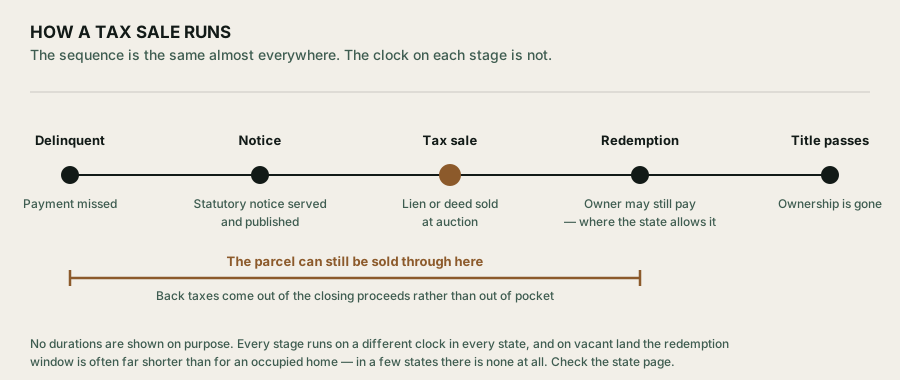
Florida sells a lien first, not the land. A certificate goes to auction the year taxes go unpaid, and once a holder has kept it two years past its April 1 issuance date, they can force a Clerk of Court auction of the property, though the owner can redeem it any time before the sale is paid for.
What actually triggers a Florida tax deed sale?
A tax deed sale is triggered when a tax certificate has gone unredeemed for at least two years, not by delinquency alone. Real estate taxes become delinquent every April 1, and county tax collectors must auction a tax certificate against unpaid parcels by June 1 of that year, according to the Pinellas County Tax Collector. That certificate sale is a lien auction: investors bid down the interest rate they’re willing to accept from a statutory maximum of 18% a year, and the winning bidder effectively pays the owner’s back taxes in exchange for that return; county-held certificates that go unsold carry the full 18% rate, per the Palm Beach County Constitutional Tax Collector. Nothing about property ownership changes at this stage: the owner still holds title and can pay off the certificate at any point.
The clock that actually matters for losing the land starts here. Under Florida Statutes § 197.502, the certificate holder may file a tax deed application “at any time after 2 years have elapsed since April 1 of the year of issuance.” A certificate issued in 2023, for instance, cannot become the basis for a tax deed application until 2025 at the earliest. The application goes to the county tax collector, not the court, and the applicant has to pay the tax collector every other outstanding certificate, interest, current taxes, and the costs of bringing the property to sale — property information searches, mailing, and title work among them, per the same statute. If the applicant does not pay those costs within 30 days of being billed, the tax collector cancels the application outright.
How does the Clerk of Court’s online auction actually work?
Once the tax collector’s office processes the application, the Clerk of the Circuit Court takes over and runs the sale as a public online auction, almost always through a third-party bidding platform. Counties including Pasco, Brevard, Orange, and Pinellas conduct these sales electronically rather than on courthouse steps, with bidders registering in advance and funding a deposit account before they can place a bid, according to the Pasco County Clerk & Comptroller. Before the auction opens, the Clerk advertises the parcel once a week for several consecutive weeks and mails notice to the owner and any lienholders of record, since a tax deed extinguishes most junior liens and a defective notice can undo the whole sale later.
The opening bid is not the back-tax amount alone. It is calculated to cover everything the applicant already paid — redemption of other certificates, accrued interest, current taxes, and sale costs — and, if the property carries a homestead exemption, an additional amount equal to half the property’s most recently assessed value, according to the Brevard County Clerk of the Court. A winning bidder generally has to post a non-refundable deposit of 5% of the bid or $200, whichever is greater, immediately when the auction closes, per the same source, with the balance due by a strict deadline, often noon or early afternoon the next business day. Miss that deadline and the deposit is forfeited, the bidder can be barred from future sales, and the property goes back up for auction.
| Stage | Who handles it | Typical timing |
|---|---|---|
| Taxes become delinquent | County tax collector | April 1 |
| Tax certificate auctioned | County tax collector | By June 1 of the delinquency year |
| Certificate holder may apply for a tax deed | Tax collector receives application | 2 years after April 1 of certificate issuance |
| Notice advertised and mailed | Clerk of the Circuit Court | Weekly for several weeks before sale |
| Property auctioned online | Clerk of the Circuit Court | Roughly 3–6 months after application, per county |
| Winning bidder pays balance | Clerk of the Circuit Court | Next business day, by a fixed deadline |
| Surplus funds claim window | Clerk of the Circuit Court | 120 days after Notice of Surplus is mailed |
Timing varies by county: this table reflects the general sequence described by the sources above, not a guaranteed calendar for any single parcel.
When does the redemption window actually close?
The redemption window in Florida stays open longer than most owners expect: all the way up to the moment full payment for the tax deed is actually made to the Clerk, not just up to the start of the auction. Florida Statutes § 197.472 states that a person may redeem a certificate “at any time after the certificate is issued and before a tax deed is issued,” and redemption requires paying the certificate’s face value plus interest and fees back to the tax collector. Because tax deed issuance follows the winning bidder’s final payment, that means an owner watching an online auction in real time can, in principle, redeem while bidding is still active, and the sale of that parcel is pulled or canceled. Practically speaking, this is a narrow and stressful window to rely on, not a plan: wiring the exact redemption amount to a tax collector’s office minutes before an auction closes leaves no room for a processing delay or a wrong figure.
Once the redemption deadline passes and a bidder’s payment is accepted, the outcome is close to final. The Clerk issues and records the tax deed, and Florida law gives the former owner very limited routes to reverse a completed tax deed sale, generally involving proof the county failed to follow its own notice procedures. That is different from a mortgage foreclosure, where a defaulted borrower sometimes has post-sale reinstatement rights; in a Florida tax deed sale, once the deed is recorded, the redemption right is gone.
What happens to the money if the winning bid exceeds what was owed?
Florida tax deed auctions frequently sell for more than the certificate holder’s opening bid, and that difference does not go to the county: it becomes surplus proceeds. When a property draws competitive bidding, the amount collected above the statutory opening bid is held by the Clerk of the Circuit Court, which pays any valid liens of record, especially governmental liens, out of that surplus before anything else goes out, according to the Pasco County Clerk & Comptroller. Whatever remains after those liens are satisfied is what the person who held legal title immediately before the sale can claim. If that owner is deceased, heirs can generally claim in their place with the right documentation.
The claim window is not indefinite. Most clerks apply a 120-day deadline from the date the Notice of Surplus is mailed, and claims typically require a notarized form along with government-issued identification. After the claim period closes, the clerk’s office resolves any competing claims — from lienholders or multiple heirs, for example — and can file an interpleader action in court if it cannot sort out who is owed what. An owner who moved out of state and left a stale mailing address on file with the property appraiser is the person most likely to miss this notice entirely, since it goes to the address of record rather than wherever the owner currently lives.
What should a landowner facing this process actually do?
The most useful thing an owner facing a Florida tax deed application can do is treat the two-year certificate window as the real deadline, not the auction date itself. By the time a Notice of Application for Tax Deed shows up, a certificate has typically already sat unpaid for two years plus however long the tax collector took to process the application, and the Florida Department of Revenue confirms that tax collectors, not the courts, control certificate sales and delinquency notices in the first place, meaning the earliest and clearest warnings arrive well before the Clerk of Court gets involved.
For an owner who has land tied up in this process and does not want to fight to keep it, options besides letting it go to auction include paying off the certificate directly, working out a plan with the tax collector before an application is filed, or selling the parcel to someone willing to close with the back taxes settled out of proceeds at closing, a path some vacant-landowners use through outlets like AMM Land Sales, which contracts to purchase land in Florida and other states and pays closing costs. Owners weighing that route alongside a straight sale can start on the site’s Florida land page, and anyone unfamiliar with terms like tax deed, redemption period, or tax lien can check the site’s glossary before deciding. Whatever path an owner picks, the two-year certificate clock and the auction-day redemption cutoff are the two dates worth writing down first.