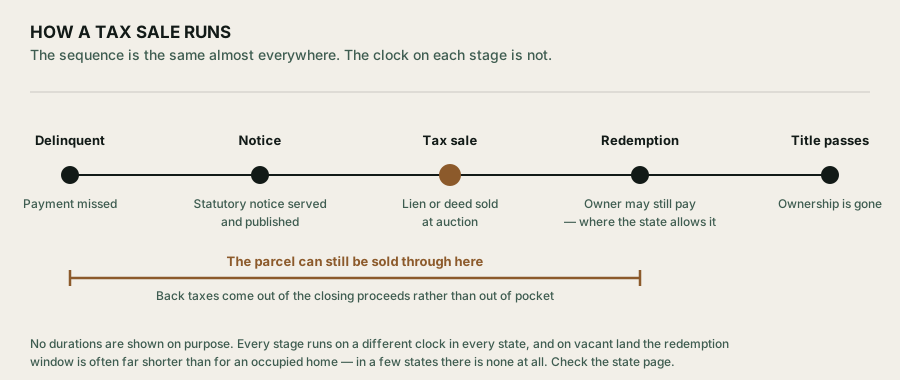
States collect delinquent property taxes two structurally different ways. Lien states sell the debt and let you keep title for years while it accrues interest; deed states eventually sell the land itself, and once an auction date is set, your right to pay it off can end the day before the sale, permanently.
What’s the difference between a tax lien state and a tax deed state?
In a tax lien state, the county auctions the unpaid tax bill, not the land. The winning bidder receives a certificate and a claim to interest, while the property owner keeps the deed until a certificate holder eventually forces a transfer through the courts or the treasurer’s office. In a tax deed state, the county skips that middle step: once taxes go delinquent long enough, the county itself auctions the property, and the winning bidder can walk away with title.
The practical difference for a seller is when the clock actually runs out. A lien system spreads the risk out over years, with interest piling up the whole time but no single hard deadline until a deed is actually applied for. A deed system holds off longer before anything happens, then compresses everything into one scheduled auction date that a seller cannot negotiate around after the fact.
Neither system is uniformly faster or slower. It depends on where you are in the process. A parcel one month into delinquency in a deed state may have more breathing room than a parcel three and a half years into an unredeemed lien in a lien state, even though the deed state’s overall structure sounds more permanent. County-level practice also varies within a single state: some county treasurers file deed applications the moment a lien is eligible, others let certificates sit for years past the statutory floor because doing the paperwork costs the certificate holder time and money. Assume the earliest legal date is possible, not guaranteed, and confirm the actual filing status with the county rather than working backward from the statute alone.
| Tax lien state (Colorado) | Tax deed state (California) | |
|---|---|---|
| What’s auctioned | The tax debt (a certificate), per Gunnison County | The land itself, per California Revenue and Taxation Code § 3691 |
| Who holds title in the meantime | The original owner | The original owner, until the county’s power to sell |
| Earliest a final transfer can happen | 3 years after the lien sale | 5 years after default (3 for nonresidential commercial, in counties that elect the shorter period) |
| When the ability to sell/redeem ends | Once a treasurer’s deed is recorded | Close of business the day before the scheduled auction |
| Post-final-action redemption | None | None |
How does Colorado’s tax lien system change your timeline to sell?
Colorado sells the lien, not the land, at each county’s annual tax lien sale, and the certificate holder cannot even apply for a treasurer’s deed until at least three years have passed from the date of that sale, under Colorado Revised Statutes Section 39-11-120. That three-year floor is a minimum, not a typical timeline: plenty of certificates sit unredeemed well past it before anyone files for a deed. During all of that time, you still hold legal title and can sell, refinance, or otherwise deal with the property as you normally would.
The certificate accrues interest the whole time, calculated as nine percentage points above the federal discount rate as of September 1 each year, per Gunnison County’s explanation of the process. You can redeem, meaning pay off the certificate plus interest, at any point before a treasurer’s deed is recorded, and so can a buyer who purchases the land from you and inherits the payoff figure at closing. Once the three-year floor passes, the certificate holder can apply for a treasurer’s deed, and current law requires the treasurer to give formal notice first: publishing notice of the application in a local newspaper and mailing it to the owner and any other interested party whose address can be found, three to five months before a deed can issue, under Colorado Revised Statutes Section 39-11-128. If the property is still unredeemed once that notice period runs, the treasurer makes out the deed and delivers it directly to the certificate holder; Colorado law does not put this transfer through a public auction. Redemption rights end only when the treasurer’s deed is actually executed and delivered, not when the three-year floor is reached, and not when someone files the application.
For a seller, the practical upshot is that a Colorado lien rarely forces your hand on a specific date. What it does is grow, and it clouds the title enough that most buyers will want the certificate payoff amount from the county treasurer confirmed before closing. A Colorado land parcel with an outstanding lien can still be sold, since the lien is a debt against you and not yet a transfer of the land, but the longer it sits, the larger the number a buyer or title company will need cleared at closing. That compounding is the real cost of treating a lien state’s longer runway as a reason to wait: the debt on a lien held two years past the sale date is a meaningfully bigger number than the same lien at six months, even though the ownership picture hasn’t changed at all in that time.
How does California’s tax deed system change your timeline to sell?
California gives owners five years of tax delinquency before the county gains the power to sell, under California Revenue and Taxation Code Section 3691. That statute lets a county shorten the wait to three years for nonresidential commercial parcels, but only if the county’s board of supervisors has separately elected that shorter period by ordinance or resolution; absent that local election, the five-year floor applies to commercial land the same as anything else. Property becomes tax-defaulted the day after the fiscal year’s taxes go unpaid, and from there the unpaid balance accrues an additional penalty of one and a half percent per month (18 percent a year), according to Contra Costa County. During those five years, an owner can stop the process entirely by paying the balance in full or by entering a redemption installment plan.
The structural difference shows up at the end. Once the default period runs out, the tax collector records a formal notice of the power to sell, per Humboldt County’s tax-defaulted property FAQ, and the property can then be scheduled for public auction. Redemption rights don’t vanish the moment that notice is recorded: an owner can still pay off the full balance and stop the sale, but they do vanish abruptly: the right to redeem “terminates at the close of business on the last business day before the actual sale,” per Contra Costa County, and California provides no extended right of redemption after the auction closes. There is no grace period, no partial-payment option once the sale date arrives, and no reopening the window afterward.
That makes California’s version of the deadline less forgiving than Colorado’s in one specific way: a lien state’s minimum floor (Colorado’s three years) is just the earliest a deed application can be filed, with real slack afterward, while a deed state’s final cutoff is a hard stop tied to a specific calendar date. An owner sitting on California land with back taxes has years to act during the default period, but should not assume there’s flexibility once an auction has actually been scheduled. Michigan runs a similarly deed-based system with its own forfeiture-to-foreclosure timeline, covered in more detail in this site’s piece on selling land before Wayne County’s tax auction, and Florida’s tax certificate process — where a certificate can trigger a county auction but the owner can still redeem up until the winning bid is actually paid — is broken down in how Florida’s tax deed auction process actually works.
What about hybrid and redeemable deed states like Georgia?
A handful of states don’t sort cleanly into either category. Georgia sells a deed at the tax sale itself, similar to a straight deed state, but the original owner keeps a statutory right to redeem that deed for a defined window afterward, similar to a lien state’s redemption period — and that right can itself be sold or transferred while it lasts. The mechanics matter more than the label: a redeemable deed state can look, on paper, like the land already changed hands, while the owner’s practical position is closer to a lien state’s. This site’s deep dive on Georgia’s redeemable tax deed walks through that specific mechanism and the notice process that eventually cuts the redemption right off for good.
The lesson for any owner facing back taxes, regardless of state, is that the label on the county’s process — lien, deed, or redeemable deed — tells you almost nothing on its own. What matters is two numbers: how long before the county or a certificate holder can take final action, and what specific event closes that window for good. Those two numbers vary by state and sometimes by county, and guessing wrong in either direction either wastes a real opportunity to sell or creates false urgency.
What should you do if you’re behind on land taxes and want to sell?
Start by identifying which system your state runs and get the exact current payoff figure from the county treasurer or tax collector, not an estimate, since interest and fees compound differently under each system. Then find out precisely what event ends your window: a treasurer’s deed recording in a lien state, a scheduled auction date in a deed state, or a barment notice in a redeemable deed state. Selling before that event happens is usually possible in every one of these systems, because in all three you still hold enough of an interest in the property to convey it; what changes is how much runway you have and how firm the deadline is once it arrives.
| Step | Why it matters |
|---|---|
| Confirm your state’s system (lien, deed, or hybrid) | Determines whether your real deadline is years away or a fixed calendar date |
| Get the exact payoff figure from the county | Interest and penalty math differs by state; estimates run high or low |
| Identify the specific cutoff event | A recorded deed, a scheduled auction, or a barment notice — not the delinquency date itself |
| Decide whether to redeem, sell, or let it run | Selling before the cutoff is usually still an option in all three systems |
A sale can typically move faster than either a treasurer’s deed application or a scheduled county auction, since it doesn’t require notice periods to other lienholders the way a forced transfer does. A buyer who contracts to purchase land directly can structure the closing so delinquent taxes are settled out of the sale proceeds rather than requiring the owner to clear the county balance first — AMM Land Sales works this way, paying closing costs and settling delinquent property taxes from the proceeds at a licensed title company, and can be reached at (815) 384-6153 to talk through a specific county’s numbers. Whoever you sell to, get the county’s payoff amount and cutoff date in writing before you sign anything, and see this site’s guide on selling land with back taxes and the broader selling problem land hub for more on financing and timeline questions specific to distressed land. For the underlying vocabulary, the glossary defines tax lien, tax deed, and redemption period in plain terms.
None of this is a reason to panic the moment a tax bill goes unpaid, and it isn’t a reason to assume you have unlimited time either. The honest answer is that it depends on the state, the county, and how far along the process already is — which is exactly the information a county treasurer’s office will give you directly if you call and ask where a specific parcel stands. That single phone call, made early, generally does more to protect your options than any general rule of thumb about lien states versus deed states.