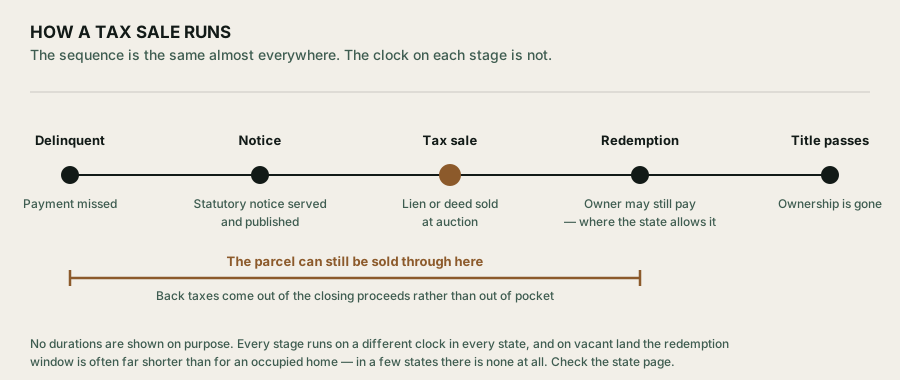
Under O.C.G.A. § 48-4-42, Georgia gives owners at least 12 months to redeem land after a tax sale by repaying the buyer plus a 20 percent premium. That right does not expire automatically at 12 months; it stays open until the buyer completes a notice process called barment, and until then the interest can be redeemed or sold.
Is Georgia a tax lien state or a tax deed state?
Georgia is neither one in the way Illinois (a lien state) or California (a pure deed state) are usually described; it runs a hybrid system commonly called a redeemable tax deed. When property taxes go delinquent, the county issues a tax execution (called a fi fa) and the sheriff sells the property at auction, so the winning bidder walks away with an actual deed, not a certificate or a lien position. That deed does not, however, give the buyer clear ownership right away. The former owner, and anyone else with a recorded interest in the parcel, keeps the right to redeem the property for at least a year, and often longer, before the buyer can force that right closed through a court-adjacent notice process. In practice, this means the tax sale itself transfers only a defeasible title, one that can still be undone if the redemption price is paid in time. The buyers at these sales are often investors bidding for the redemption premium itself rather than for the land, since redemption is a common outcome under this structure. That is also why counties can move to auction relatively quickly once taxes go delinquent while still leaving a real cushion for an owner to catch up.
How much does it cost to redeem land sold at a Georgia tax sale?
Redemption costs the amount the buyer paid at the sale plus a 20 percent premium for the first year, with an additional 10 percent added for every year or partial year after that. According to Camden County’s redemption page, the redemption price includes the original tax deed purchase price, any subsequent taxes the deed holder paid, a 20 percent premium for the first year or fraction of a year, and an additional 10 percent for each subsequent year until redemption. Hall County’s tax commissioner confirms the 20 percent premium and notes that the tax deed purchaser, not the county, is responsible for calculating the exact amount owed, which is one reason redemption negotiations can get contentious.
| Time since tax sale | Premium owed on top of price paid and taxes |
|---|---|
| Within year 1 (any part of it) | 20% |
| Into year 2 | 30% total |
| Into year 3 | 40% total |
| Into year 4 | 50% total |
That escalation is why waiting is expensive. A parcel that sold for $15,000 at the courthouse steps costs an owner $18,000 to redeem in month 11, according to the same 20-percent formula cited by Camden and Hall counties, but the math pushes past $19,500 if the owner instead waits into a thirteenth month, before even counting any taxes the buyer paid in the meantime.
What is barment, and when can the buyer use it?
Barment, formally the foreclosure of the right to redeem, is the legal notice process a tax deed buyer must complete before the owner’s redemption right disappears for good, and the buyer cannot even start it until a full year has passed since the sale. Under O.C.G.A. §§ 48-4-45 through 48-4-48, the buyer has to identify everyone with a recorded interest in the property, including the former owner, any occupant, and any lienholders, and serve each of them formal notice. According to Your Hometown Attorney, that means a title examination to find every interested party, individual notice by certified mail, and newspaper publication once a week for four straight weeks. Who has to be notified generally includes:
- The taxpayer who owned the property at the time of the sale
- Any current occupant of the property
- Every lender, HOA, or other party with a lien recorded against the property
- Anyone who has recorded a deed, assignment, or other interest since the sale
Only after that notice period runs, and the owner still has not redeemed, can the buyer record an affidavit that finally bars the right to redeem. Because the process itself takes weeks to complete correctly, an owner’s real deadline is rarely exactly 12 months; it is 12 months plus however long the buyer’s notice process takes, and a buyer who skips a required party can have the whole barment thrown out later.
Can you sell land during the redemption period?
Yes. The owner’s interest in the property does not vanish at the tax sale, and Georgia law lets anyone holding an interest in the property redeem it, which is what makes a sale or transfer during this window legally possible. According to Mitchell Weinstein, LLC, the right to redeem belongs to “an owner, creditor or other person with an interest in the property,” not just the person who owned the parcel on the day of the sale. That is a broader group than it sounds: a buyer of the owner’s remaining interest steps into that same right and can redeem in their own name. It also means an owner who cannot afford, or does not want, to pay off the rising redemption premium is not necessarily out of options between the sale and barment. Selling the equity that is left, rather than letting it get barred for nothing, is a real choice. Companies that buy vacant land directly, including AMM Land Sales, sometimes take on parcels in exactly this position; the seller still needs to disclose the tax sale and any recorded liens, and any purchase closes through a title company that can confirm what is actually still owed. For owners weighing this against redeeming the parcel themselves, AMM Land Sales’ page on land with back taxes walks through how delinquent taxes typically get handled at closing.
What should an owner check before deciding what to do?
Before choosing between redeeming, selling, or doing nothing, an owner needs three current numbers: the exact redemption payoff, whether a barment notice has already been sent, and whether any excess funds exist from the sale. Athens-Clarke County’s right of redemption page notes that the redemption amount and any applicable notice costs change depending on when the redemption is made relative to the foreclosure notice, so a figure that was accurate a month ago may already be out of date. A short checklist before making a decision:
- Confirm the exact tax sale date and buyer of record with the county tax commissioner
- Ask in writing whether a foreclosure (barment) notice has been sent or recorded yet
- Get the current redemption payoff amount in writing, since it increases with time
- Check whether the sale generated excess funds separate from the redemption right
- Have a title search run before assuming which older liens still attach to the parcel
Skipping this step is what turns a solvable situation into a lost one; an owner who assumes they have “the full year” when a barment notice already went out weeks ago can run out the clock without realizing it.
What happens to money left over after the sale?
If a property sells at the tax sale for more than what was owed, the county holds the difference as excess funds, and the former owner or any recorded lienholder can claim it directly. Chatham County’s tax commissioner explains that claims have to go straight to the county in writing, with proof of identity and proof of interest in the property; the office does not work through third-party recovery firms or powers of attorney, and reviews typically take three to four weeks. Unclaimed excess funds transfer to the Georgia Department of Revenue after about five years, after which recovering them requires a court order. Excess funds are a separate pot from redemption: redemption buys the property back outright, while excess funds are only the leftover cash if the property was never redeemed and sold for more than the debt owed. When more than one party claims the same excess funds, such as a former owner and a mortgage lender both filing, Chatham County’s process allows the tax commissioner to send the dispute to Superior Court through an interpleader action rather than deciding who is owed what itself. Other Georgia counties generally follow the same broad framework, though the exact claim form and processing time vary by office.
How does Georgia’s system compare to other states?
Georgia’s minimum 12-month, 20-percent-premium redemption window sits in the middle of a wide range nationally, and the fact that a deed changes hands immediately at the sale, unlike in a pure lien state, is what makes the redemption period and barment matter so much here. States that sell tax liens rather than deeds, such as Illinois, put a certificate in the buyer’s hands and leave the owner holding actual title until a court forecloses; deed states like California typically sell full title outright with no redemption at all. Some states move faster than Georgia’s floor of a year: Wayne County, Michigan forfeits delinquent land after about a year and can finalize foreclosure within two, with no 20-percent buyback built in at all. Other Southeastern states run their own versions of a redeemable deed with different math and timelines, so an owner who has land in more than one state should not assume Georgia’s 12-month, 20-percent structure applies elsewhere. Georgia’s structure gives an owner more time and a defined cost to reclaim land than many foreclosure-style states do, but that time is not indefinite and it is not automatic. An owner who ignores the notices a buyer is required to send can still lose the land once barment is complete, at which point O.C.G.A. § 48-4-42’s redemption formula stops applying altogether.
Owners who are unsure whether a specific parcel’s redemption right is still open should check the sale date and any barment notices with the county tax commissioner directly, since county offices, not the state, hold the sale records and calculate what is currently owed. AMM Land Sales does not represent sellers or file legal notices on their behalf, but for an owner deciding between paying a rising premium and selling what is left of their interest, how AMM Land Sales’ process works and the redemption period and tax deed entries in the glossary are useful starting points before that deadline gets closer.