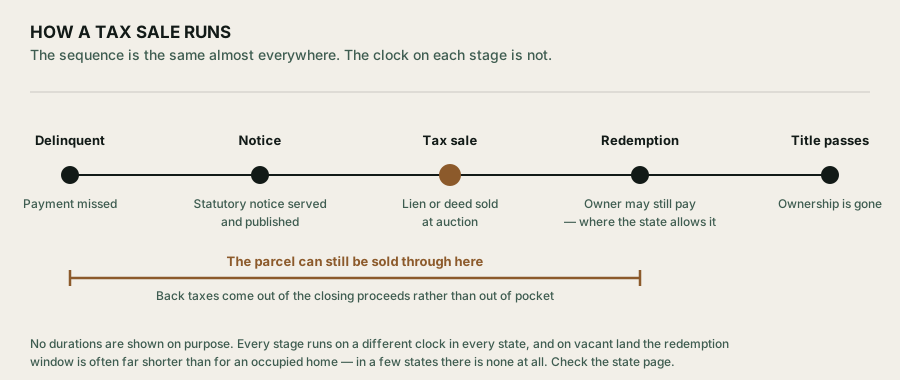
Redemption costs the delinquent taxes owed, plus interest or a statutory premium, plus taxes the buyer paid after the sale, plus county and indemnity fees. In Illinois, per DuPage County, that premium can run 12% to 18% or more; in Colorado it’s a flat annual rate, around 14% for the 2025 sale year per El Paso County.
If you’re the person who used to own this land and it went to a tax sale, the question isn’t abstract. Somebody now holds a certificate or a deed with your name on the old tax bill, and every county handles the buyback differently. Two states with very different mechanics, Illinois and Colorado, show what the actual math looks like and what it takes to answer the real question: is this parcel worth paying to get back?
What do you actually have to pay to redeem land?
You pay back the unpaid tax debt, statutory interest or a premium on top of it, whatever the tax buyer paid in taxes after the sale (also with interest or penalty added), and a set of county-level fees that exist specifically to fund the sale and record-keeping system. None of that is optional or negotiable with the buyer directly in most states; it is a formula set by statute and calculated by the county. According to DuPage County’s tax redemption page, an owner has to contact the county clerk for an “estimate of redemption,” since the figure changes as interest accrues and as the buyer pays subsequent years’ taxes. The pieces that typically stack up are:
| Component | What it is |
|---|---|
| Delinquent tax amount | The original unpaid taxes that triggered the sale |
| Interest or premium | Statutory rate or the rate bid by the buyer at auction |
| Subsequent taxes paid by buyer | Taxes the buyer covered after the sale, usually with its own penalty |
| County/indemnity fees | Sale costs, publication, certified mail, indemnity fund contribution |
| Legal/title costs | Added late in the period if the buyer has filed for a deed |
How does redemption work in a tax lien state like Illinois?
In Illinois, the county sells a certificate against the unpaid taxes rather than the land itself, so the former owner keeps legal title and can redeem any time before the redemption period runs out and a court issues a tax deed. Redemption periods vary by property type: owner-occupied residential parcels of six units or fewer get up to three years, but vacant, non-farm property carries a shorter window. For certificates issued under the state’s current Property Tax Code, that window is 12 months; certificates issued before January 1, 2024 could carry a shorter, 6-month window under the prior rule, according to Illinois Legal Aid Online’s summary of the redemption timeline. That distinction matters directly for vacant land: a rural lot can carry a far shorter clock than a house down the road from it, and the buyer can extend the period up to three years total but has no obligation to.
The cost side has several moving parts. According to DuPage County, the buyer’s bid penalty applies immediately at the rate bid at auction, up to a legal cap of 18%, and then steps up again every six months the certificate remains unredeemed: 1x the bid rate in months 0-6, 2x in months 6-12, 3x in months 12-18, and so on. Any taxes the buyer pays in subsequent years carry their own separate 12% annual penalty. On top of that, McLean County’s tax sale fee schedule lists a $20 per-parcel indemnity fee (with another $20 added for each year the buyer pays subsequent taxes), an automation fee of up to $10, and a $10 charge for certified mailing and publication costs. None of those fees is large by itself, but they add up alongside the interest, and DuPage’s page also notes legal costs get layered on within the final month before the redemption period closes if the buyer has already filed for a deed.
A rough example: a parcel with $2,400 in delinquent taxes sold at the maximum 18% bid penalty, redeemed 14 months after the sale, falls into the third six-month bracket (months 12-18), so the bid penalty applies at 3x the bid rate: $2,400 x 18% x 3, or roughly $1,300. Add one additional year of subsequent taxes the buyer paid, say another $2,400, plus its own 12% penalty (about $290), and $150 to $200 in county and indemnity fees, according to the fee structures described by DuPage and McLean County. That puts a realistic payoff in the neighborhood of $6,500 to $6,600 on the original $2,400 debt once a second year of taxes and its penalty are included, and it’s the stepped bid-penalty structure, not a flat one-time premium, that does most of the damage the longer redemption drags on. The county clerk’s actual estimate of redemption is the only figure that should be relied on for a real decision, since exact penalty timing varies by the buyer’s bid and by how many subsequent tax years have been paid.
Illinois also allows redeeming “under protest,” a process Illinois Legal Aid Online describes as available once a tax buyer has petitioned the court for a deed: an owner deposits the redemption amount plus paperwork with the county clerk while preserving the right to argue in court that the sale itself was improper. It’s a narrow option, not a way to redeem for less, but it matters if there’s a real dispute over whether the sale should have happened at all.
How does redemption work in a tax lien state like Colorado?
Colorado also sells a lien certificate rather than the land, and gives the former owner three years from the sale to redeem, though in practice the right stays open until the certificate holder completes a public auction process for the treasurer’s deed. According to El Paso County’s Treasurer’s Office, the annual interest rate on the 2025 tax lien sale was 14%, which is set under state law at nine percentage points above the federal discount rate each September and applies for the life of that year’s certificates. Jefferson County confirms the same three-year structure and notes that redemption requires paying the delinquent taxes plus all interest accrued since the sale, in cash or certified funds only.
One quirk that changes the math in Colorado’s favor for an owner: if a bidder pays a premium over face value to win the certificate at auction, that premium is not refunded on redemption and does not earn interest, according to both El Paso and Jefferson County. Interest only accrues on the actual delinquent tax amount. So a lien that sold for well above its face value because two investors bid it up doesn’t necessarily cost the former owner more to redeem than a lien that sold at face value; the premium is effectively the investor’s own risk, not a cost passed to the owner.
Redemption itself is fairly clean math: taxes owed, plus simple interest at that sale year’s rate for the time the certificate has been outstanding, with no separate percentage-based premium layered on top the way Illinois adds a bid penalty. Applying the 14% rate reported by El Paso County to the same $2,400 debt redeemed after 14 months works out to roughly $2,400 plus about $390 in interest, close to $2,800 total, before any county processing fee. That’s a materially cheaper redemption than the Illinois example above on the same underlying debt and timeframe, mostly because Colorado’s rate is fixed annually rather than stepping up every six months toward an 18% cap the way Illinois’ bid penalty can.
What happens if the land isn’t redeemed in time?
Once the redemption period runs out, the certificate or lien holder still has to complete a formal process before getting a deed, and that process is where any leftover value gets decided. In Colorado, HB24-1056, effective July 2024, ended the old rule that treasurers automatically issued a deed to whoever held the certificate; instead the option to buy a treasurer’s deed now has to be sold at public auction, and any bid above the minimum, the “overbid,” gets paid first to junior lienholders and then to the former owner. That change exists specifically because the U.S. Supreme Court’s 2023 ruling in Tyler v. Hennepin County held that a government keeping value above the tax debt itself amounts to an uncompensated taking, a point the Colorado Bar Association’s own publication walks through in Keeping the Surplus?. Illinois runs a comparable surplus process through its own tax deed and sale-in-error procedures, though the mechanics and deadlines to claim any leftover funds differ by county and are worth confirming directly with the county clerk before assuming nothing is recoverable.
When does redeeming actually make financial sense?
Redeeming makes sense when the payoff, once you have the county’s actual figure in hand, is meaningfully less than what the land is worth and less than what you’d spend defending or reselling it afterward. That’s a comparison, not a formula, and it only works with real numbers on both sides: an estimate of redemption from the county, not a guess, against a realistic sense of what the parcel would actually bring if sold. Per the Illinois math worked out above, a $2,400 debt ballooning to roughly $6,500 on a lot worth $15,000 is still a reasonable yes. The same payoff on a landlocked, hard-to-access lot nobody has made an offer on in years is a genuinely close call, especially once you count the taxes that will keep coming due every year after redemption too.
A short list of what to check before deciding either way:
- Get the current, county-issued redemption figure in writing, not an estimate from memory or an old tax bill
- Confirm exactly how much time is left, since Illinois in particular can cut vacant land’s window to 12 months, or as little as 6 months on older certificates
- Ask whether the buyer has already filed for a deed, since legal costs get added late in the period
- Get a realistic sense of the land’s current value, not what it was worth when you bought it
- Check whether the county holds any surplus from the sale that could offset what’s owed, or that you could claim separately if the land isn’t redeemed
For an owner who decides the payoff doesn’t pencil out, selling whatever interest remains before the deadline is sometimes the more sensible move than either paying a rising redemption bill or losing the parcel outright. AMM Land Sales’ page on land with back taxes covers how delinquent tax debt is typically handled out of closing proceeds when a sale happens before that point, and the redemption period and tax lien glossary entries define the terms used across state statutes that don’t always use the same language for the same idea.
How do these two states compare to what’s typical elsewhere?
Illinois and Colorado are both lien states, meaning the county sells a certificate against the debt rather than the property, but they price redemption very differently: according to the county sources above, Illinois steps its bid-based penalty up every six months toward an 18% cap plus a separate 12% on subsequent taxes, while Colorado charges one annually-set interest rate with no premium refund. States that sell full tax deeds outright, rather than liens, often skip a redemption period entirely or attach a flat one-time premium instead of compounding interest, which is a different cost curve altogether. An owner who holds land in more than one state should not assume the mechanics, or the deadline, transfer from one parcel to the next; the redemption period definition is a shared term, but the number behind it is set state by state, and sometimes county by county within a lien state’s own rules on fees.
Before making a final call on any specific parcel, confirm the current payoff and the exact deadline with the county treasurer or clerk’s office directly, since the figures above are worked examples built from published statutory formulas, not a substitute for the county’s own current number. Owners weighing whether it’s worth catching up versus selling can also review how AMM Land Sales’ process works for a sense of what a sale before that deadline looks like in practice.