Reference
Land terms, defined.
Land has its own vocabulary, and most of it is only ever explained to you once, usually at the point where it has already cost you something. These are the terms that decide what a parcel is worth and whether a sale closes.
Title and ownership
- Abstract of title
-
A condensed history of every recorded document affecting a parcel — deeds, mortgages, liens, easements and judgments — assembled in date order.
Still the customary evidence of title in a handful of states where title insurance never displaced it.
- Chain of title
-
The sequence of recorded owners of a parcel, each transfer linking to the next, running from the present owner back through time.
A break in the chain — a deed that was never recorded, or an heir who never signed — is the most common reason a land sale cannot close.
- Cloud on title
-
Any recorded claim, encumbrance or irregularity that casts doubt on an owner’s title without necessarily defeating it.
Most clouds are cheap to clear and expensive to ignore. They are found by a title search, not by looking at the deed.
- Quitclaim deed
-
A deed that transfers whatever interest the grantor happens to have in a parcel, with no warranty that they have any interest at all.
Useful for clearing up a defect between parties who trust each other. A poor instrument for buying land from a stranger.
- Warranty deed
-
A deed in which the seller warrants that they hold good title and will defend it against claims — in a general warranty deed, against all claims arising at any time in the parcel’s history.
The strongest ordinary deed. A special or limited warranty deed narrows the promise to the seller’s own period of ownership.
- Title commitment
-
A title insurer’s written offer to issue a policy on a parcel, listing what it will insure, what it requires before closing, and what it refuses to cover.
The exceptions schedule is the part worth reading. It is where easements, mineral severances and survey gaps appear.
- Heirs’ property
-
Land inherited without a will or a probate, so that ownership passes to multiple descendants as tenants in common, often across several generations and dozens of people.
Any one co-tenant can normally force a sale of the whole parcel. Nobody can convey clear title alone.
- Tenancy in common
-
Co-ownership in which each owner holds a separate, undivided fractional share that they may sell or leave by will independently of the others.
Shares need not be equal, and there is no right of survivorship — which is what turns a single inheritance into heirs’ property.
- Partition action
-
A lawsuit by a co-owner asking a court to divide jointly held land physically, or to order it sold and the proceeds split.
The usual endgame when co-owners of inherited land cannot agree. Many states have adopted the Uniform Partition of Heirs Property Act to make a forced sale harder.
- Mineral rights
-
The ownership of the substances beneath the surface of a parcel, which can be sold or reserved separately from the surface itself.
Where minerals have been severed, the mineral owner generally has the right to use the surface reasonably to reach them.
- Severed estate
-
A parcel whose surface and subsurface rights are owned by different parties, usually because a prior owner sold or reserved the minerals.
Common across the plains and the west, and not always visible on an assessor record.
Access and boundaries
- Legal access
-
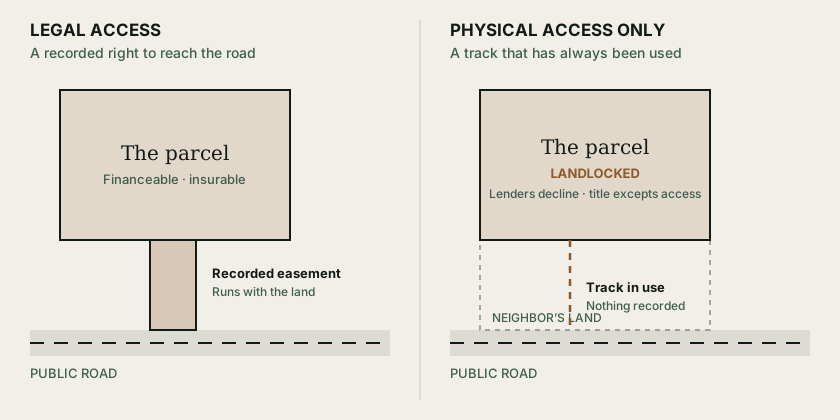
A recorded right to reach a parcel from a public road, either by direct frontage or by an easement written into the record.
The distinction from physical access is the single most consequential one in vacant land. A track that has always been used is not legal access.
- Landlocked parcel
-
A parcel with no recorded legal access to a public road, so that reaching it requires crossing land belonging to someone else.
Lenders will generally not finance one and title insurers will except access from coverage, which is why the discount is steep.
- Easement
-
A recorded right to use part of someone else’s land for a stated purpose — most often access, but also utilities, drainage or conservation.
An easement runs with the land rather than with the owner, so it survives a sale in both directions.
- Easement by necessity
-
An access right a court may imply where a parcel was cut off from a public road by a division of land that had previously included access.
It has to be litigated, it depends on the history of the division, and it is not a substitute for an easement in the record.
- Prescriptive easement
-
An access right acquired by using someone else’s land openly, continuously and without permission for the period a state’s law requires.
Permission defeats it. A neighbor who has been allowed to cross is not acquiring a right by doing so.
- Metes and bounds
-
A boundary description that walks the perimeter of a parcel in bearings and distances from a defined starting point, returning to where it began.
The older of the two systems, standard in the original thirteen states and Texas. Errors compound around the loop.
- Public Land Survey System
-
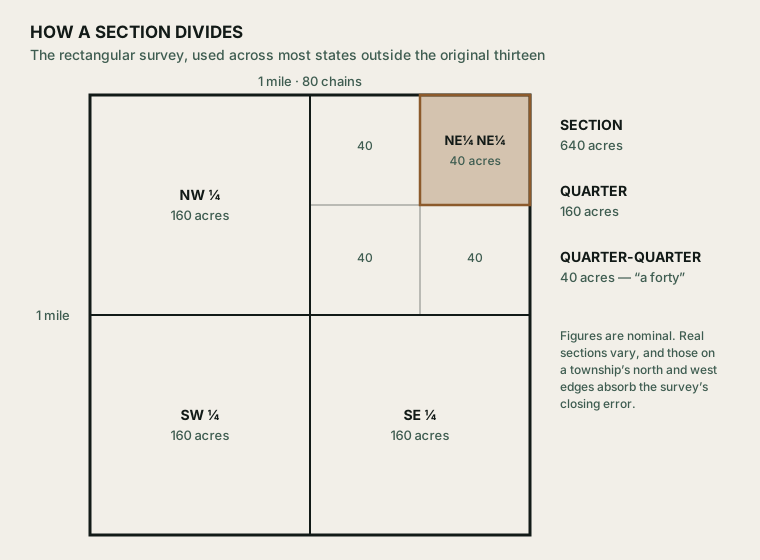
The federal rectangular survey that divides most land west and north of the original colonies into townships, ranges and numbered sections of roughly one square mile.
A section is about 640 acres, so a quarter-quarter section — the classic "forty" — is about 40 acres.
- Plat
-
A recorded map showing a parcel’s boundaries, dimensions, easements and its relationship to neighboring parcels and roads.
A plat is a map, not a survey. It shows what was recorded, not what a surveyor found on the ground today.
- Encroachment
-
A structure or improvement that extends across a boundary onto a neighboring parcel — a fence, a driveway, the corner of a building.
On vacant land the usual encroachment is a fence built on convenience rather than on the line, which a survey then exposes.
Money and taxes
- Assessed value
-
The value a county assessor places on a parcel for the purpose of calculating property tax.
It is not market value and is frequently far from it in either direction. It is the number most often mistaken for what land is worth.
- Tax lien
-
A claim a taxing authority places on a parcel for unpaid property tax, which takes priority over most other recorded claims including mortgages.
In lien states the lien itself is sold to investors; the owner keeps title until a separate later step.
- Tax deed
-
A deed conveying a parcel to a purchaser at a sale held because property taxes went unpaid, extinguishing most prior interests.
In deed states the sale transfers ownership directly rather than selling a lien against it.
- Redemption period
-
The window after a tax sale during which the former owner may recover the parcel by paying the taxes, interest and costs.
Length varies enormously by state, and some states have none at all. Whether it runs before or after the sale also varies.
- Rollback tax
-
A retroactive bill for the difference between the tax paid under an agricultural or forestry assessment and what would have been paid at market value, triggered when the land’s use changes.
It follows the change in use rather than the sale, so a buyer who converts the land pays it, not the seller who sold it.
- Capital gains on land
-
Tax on the difference between what a parcel sells for and its cost basis, at long-term rates where the land was held more than a year.
Inherited land generally takes a stepped-up basis at the date of death, which frequently means far less gain than owners expect.
- Cost basis
-
What a parcel is treated as having cost its current owner for tax purposes — usually the purchase price plus capitalized improvements and certain carrying costs.
- 1031 exchange
-
A deferral under section 1031 of the Internal Revenue Code allowing gain on investment real property to be rolled into replacement property instead of being taxed at sale.
Strict deadlines apply and the proceeds must never touch the seller’s hands. It does not apply to property held for personal use.
- Comparable sale
-
A recent arm’s-length sale of a similar parcel, used as evidence of what the subject parcel is worth.
On land, "similar" means access, zoning, topography and utilities before it means acreage. Two forties a mile apart can differ by an order of magnitude.
- Price per acre
-
Sale price divided by acreage — a way of comparing parcels of different sizes, not a value that can be looked up for an area.
It falls as parcels get larger, so applying a small-parcel figure to a large one overstates value badly.
Use and restrictions
- Zoning
-
A local government’s rules governing what a parcel may be used for and what may be built on it, including setbacks, density and minimum lot size.
Some rural counties have no zoning at all, which is not the same as being free of restrictions.
- Restrictive covenant
-
A private restriction recorded against a parcel, usually by a subdivision developer, limiting what may be built or done on it.
It binds regardless of what zoning permits, and it is enforced by the other owners rather than by the county.
- Entitlement
-
The set of approvals — rezoning, platting, permits, utility commitments — that a parcel needs before it can legally be developed as intended.
Entitled land is worth substantially more than identical unentitled land, because the risk of not getting approval has been removed.
- Variance
-
Permission from a local zoning authority to depart from a specific requirement, granted where strict application would create an unnecessary hardship.
- Buildable area
-
The portion of a parcel where a structure may actually be placed once setbacks, easements, wetlands, floodplain and slope are subtracted.
On land the number that matters. A twenty-acre parcel with one buildable acre is a one-acre homesite.
- Perc test
-
A soil percolation test measuring how quickly water drains, used to determine whether a parcel can support a conventional septic system.
A failed perc on a parcel with no sewer changes what the land is, not merely what it costs.
- Wetland delineation
-
A field determination by a qualified consultant of where regulated wetlands begin and end on a parcel.
Federal jurisdiction over wetlands has moved repeatedly in the courts. A delineation from years ago may no longer describe the current rule.
- Flood zone
-
FEMA’s classification of a parcel’s flood risk, shown on Flood Insurance Rate Maps and driving both insurance cost and what may be built.
Free to check before you buy, and one of the few diligence items that costs nothing.
- Conservation easement
-
A permanent recorded restriction limiting development on a parcel, usually granted to a land trust or agency in exchange for a tax benefit.
It runs with the land forever. A buyer inherits the restriction, not the deduction.
The transaction
- Purchase and sale agreement
-
The contract setting out the price, the closing date, the conditions each side must satisfy, and what happens if either fails to.
- Assignment of contract
-
The transfer of a buyer’s rights under a purchase contract to a different buyer, who then closes in their place.
Ordinary and lawful where the contract permits it, and increasingly regulated: several states now require the assignor to disclose in writing that they are selling a contract position rather than the land.
- Due diligence period
-
A negotiated window after a contract is signed during which the buyer may investigate the parcel and, usually, withdraw for any reason.
- Earnest money
-
A deposit made when a contract is signed, held by a neutral party and credited to the price at closing, which the seller may keep if the buyer defaults.
- Escrow
-
The arrangement under which a neutral third party holds money and documents until every condition of a sale has been met, then disburses both.
In some states escrow is run by a title company, in others by a licensed attorney. It is not optional in either.
- Closing costs
-
The transaction costs of a sale — title work, recording fees, transfer taxes, escrow and attorney fees — apportioned between the parties by contract or by local custom.
- Transfer tax
-
A tax levied by a state, county or municipality on the transfer of real property, usually calculated on the sale price.
Some states levy none at all; others levy at two or three levels of government on the same sale.
- Deed recording
-
Filing the executed deed with the county so the transfer becomes part of the public record and binds later purchasers.
An unrecorded deed can be valid between the parties and still lose to a later buyer who records first.
- Remote online notarization
-
Notarising a signature over live audio-video with an approved provider rather than in physical presence.
Now permitted in most states, which is what makes it practical to sell land in a state you have never been to.
- As-is sale
-
A sale in which the buyer accepts the property in its current condition and the seller makes no promise to repair or remediate.
It does not override a state’s disclosure statute. A seller who knows of a material defect generally must still disclose it.
Where these terms are used in practice
Definitions are the start of it. What a term costs you depends on the state — a redemption period runs for a few months in one place and several years in another, and whether a closing needs an attorney is not a matter of preference. The state pages cover that state by state, and the guides take the larger ideas — access, value, tax — one at a time.
Tell us about the parcel. We will tell you what it is worth to us.
No listing agreement, no fee, and no obligation to accept anything. If we are not the right buyer for your land, we will say so.