For buyers
See parcels before they are listed.
We source land directly from owners. Buyers on this list hear about a parcel when we put it under contract, which is usually weeks before it appears anywhere public.
A land buyers list is a direct feed of parcels that are under contract but not yet advertised. Joining costs nothing and commits you to nothing. You tell us the counties you buy in, the acreage range you want and the most you will pay, and you get parcels matching those three things and nothing else.
Tell us what you buy
The more specific you are, the less irrelevant mail you get from us.
What kind of buyer is this list built for?
Roughly three. Investors who resell — they want a wide funnel, will look at anything with a defensible margin, and care most about how fast a parcel can be turned around. Builders and developers, who care about one or two counties, need zoning and utilities to line up, and will pay more for a parcel that is genuinely build-ready. And end users buying for themselves: a homesite, hunting ground, pasture, a place to put a cabin. The third group buys the fewest parcels and asks the best questions.
The form asks what you do with the land because those three want almost opposite things. A parcel that is perfect for a builder — entitled, on a paved road, utilities at the lot line — is usually the worst value for an investor, and the reverse is true of a landlocked forty with back taxes on it.
What do we tell you about a parcel, and what do we not?
We send what we hold: the parcel number, county, acreage, the legal description, what the assessor shows, the tax status, and what the owner told us about access, use and any encumbrance. Where we know a parcel has a problem, the problem is in the first email rather than discovered by you in week two. A landlocked parcel is described as landlocked.
What we do not do is verify it for you. We are not a title company, a surveyor or a licensed inspector, and nothing we send is a substitute for a title commitment and your own diligence. Where we are acting as a principal rather than an agent, we say so in writing on the deal itself. Assume every figure we pass on is the owner’s or the county’s until your own search confirms it.
What should you check before you close?
The seven things that decide whether raw land is worth what it looks like, in the order they most often kill a deal:
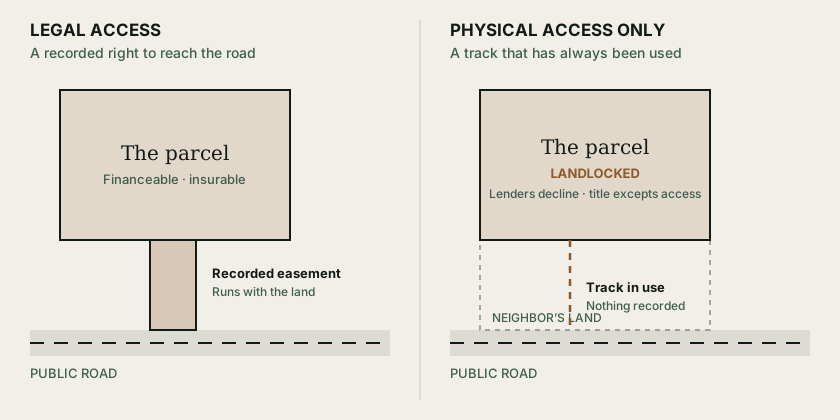
- Legal access. Recorded frontage on a public road, or a recorded easement. Not a track that has always been used.
- Title. A commitment, not a deed copy. Heirs’ property, an unreleased mortgage and an old judgment all surface here and nowhere else.
- Zoning and deed restrictions. Zoning is the county’s rule; a restrictive covenant is the subdivision’s, and it binds you even where zoning would allow the use.
- Taxes. Current balance, any delinquency, and whether an agricultural or forestry exemption is in place that a change of use would claw back.
- Flood and wetland. The FEMA zone is free to check. Wetland delineation is not, and a wetland finding can remove the buildable area entirely.
- Utilities. Distance to power, and whether the parcel will perc if there is no sewer. A failed perc test on a homesite parcel changes what it is worth, not merely what it costs.
- Mineral and water rights. Severed minerals are common in some states and do not always show on a summary. In the west, water rights are a separate asset from the ground.
Our own guides go into most of these in more depth — start with buying land and what land is worth.
Which states do we source from?
All fifty. Volume follows where land actually changes hands rather than where we would prefer it to, so Texas, the southeast and the plains produce more parcels than the northeast does. If you buy in one county only, say so on the form — a narrow filter means you hear from us rarely and relevantly, which is better for both sides than the alternative.
You can see what we know about the selling side of any state on the state pages, which cover closing practice, tax-sale timelines and disclosure rules state by state.
Questions
Buying land, answered
What does it cost to join a land buyers list?
Nothing. There is no fee, no subscription and no exclusivity agreement. You give us your counties, acreage range and price ceiling, and you receive parcels that match them. You can ask to be removed at any time and we act on it the same day.
How do off-market land parcels reach a buyers list before they are listed?
We deal directly with owners rather than through listings, so a parcel exists as a signed contract before it exists as an advertisement. Depending on the deal we either close on it ourselves and resell it, or assign our position in the contract to a buyer. Either way the list hears about it at the contract stage, which is typically weeks before anything public.
Should you buy land without visiting it?
Many land buyers do, but only against documents rather than photographs. Before closing sight unseen you want the legal description and a plat, written confirmation of legal access, the zoning and any deed restrictions, the FEMA flood zone, the tax status including any delinquency, and a title commitment. A parcel that survives all seven is usually safe to buy remotely. One that fails on access rarely is.
What is the difference between legal access and physical access?
Legal access is a recorded right to reach the parcel — a public road frontage or a recorded easement. Physical access is whether a vehicle can actually get there. A parcel can have one without the other. Land with physical access over a neighbor’s ground and no recorded easement is landlocked in every way that matters to a lender or a title company.
How quickly do buyers need to respond on an off-market parcel?
Faster than on a listed property. Because the parcel is under contract rather than on the market, there is a closing date already running. In practice a buyer who can give a yes or no within about seventy-two hours, and close in two to three weeks, sees the most deals. We say the deadline in the first email rather than making you ask.
Do you finance the land you sell?
No. We do not carry paper or offer owner financing, and we do not broker loans. Buyers on this list pay cash or arrange their own financing. If you are financing, tell us on the form — it changes which parcels are worth sending you, since a lender will not fund a landlocked parcel.
Tell us about the parcel. We will tell you what it is worth to us.
No listing agreement, no fee, and no obligation to accept anything. If we are not the right buyer for your land, we will say so.