Buying land at a county tax deed auction means bidding on a property sold “as-is,” with no warranty of title, cash due within hours of winning, and no guarantee of standard title insurance until a court clears the title. Research liens, access, and your state’s redemption rules before you register to bid.
What Actually Happens When You Register and Bid?
Most counties require you to register in advance, post a deposit tied to your winning bid, and pay the full balance within a tight window. Miss that window and you forfeit the deposit while the parcel goes back up for sale. The mechanics vary by state, and even by county within the same state, but the pattern is consistent: the county wants certified funds, fast, and it isn’t interested in financing contingencies.
Many counties now run these sales on an online bidding platform rather than a physical courthouse-steps auction, so registration itself often happens days ahead of the sale date, with the deposit posted before you’re allowed to bid at all rather than only after you win. Read your specific county’s registration page closely, since the sequence (deposit before bidding versus deposit after winning) changes what you’re committing to at each step.
This is also where vacant land specifically differs from a house or a lot with a structure on it. A raw parcel, whether it’s a rural homesite, recreational acreage, or timberland, won’t have a mortgage lender or an occupying tenant to complicate the picture the way an improved property might, but it also won’t have an address you can just drive to. Confirm the parcel identification number, legal description, and county GIS map match before you bid, not after, since “the property at this address” can be misleading or simply not exist for unimproved land.
In Florida, tax deed sales are run by the county clerk of court under Florida Statutes Chapter 197. In Brevard County, for example, a winning bidder must post a nonrefundable deposit of $200 or 5% of the bid, whichever is greater, immediately after the sale, according to the Brevard County Clerk of the Court. The clerk’s FAQ states that if the remaining balance isn’t received “by 3:00 PM on the business day immediately following the tax deed sale, per Section 197.542(2), Florida Statutes, the sale will be canceled,” and the deposit is forfeited.
Texas runs on a different framework. Tax sales there are conducted by a constable or sheriff on behalf of the taxing units, typically represented by a delinquent-tax law firm, and bidders must pay in cash or cashier’s check. Before the clerk hands over the deed, the winning bidder must present written proof that they don’t owe delinquent taxes themselves, according to Perdue Brandon Fielder Collins & Mott, a firm that handles delinquent tax sales for numerous Texas counties. Sales can also be voided later if a prior bankruptcy filing surfaces, and taxes that accrued after the judgment was entered aren’t included in the minimum opening bid: both things a bidder has to check independently before assuming the number on the auction listing is the final cost.
| Florida (example: Brevard County) | Texas (typical county) | |
|---|---|---|
| Who conducts the sale | Clerk of court | Constable/sheriff, via taxing unit’s attorney |
| Deposit at time of sale | $200 or 5% of bid, whichever is greater | Full cash/cashier’s check often required same day |
| Balance due | By 3 p.m. the next business day | Same day, in most counties |
| Warranty of title | None: “no express or implied warranties” | None: deed “without warranty” |
| Post-sale redemption | None; redemption ends when the deed is issued | 180 days (most property) or 2 years (homestead, ag, mineral) |
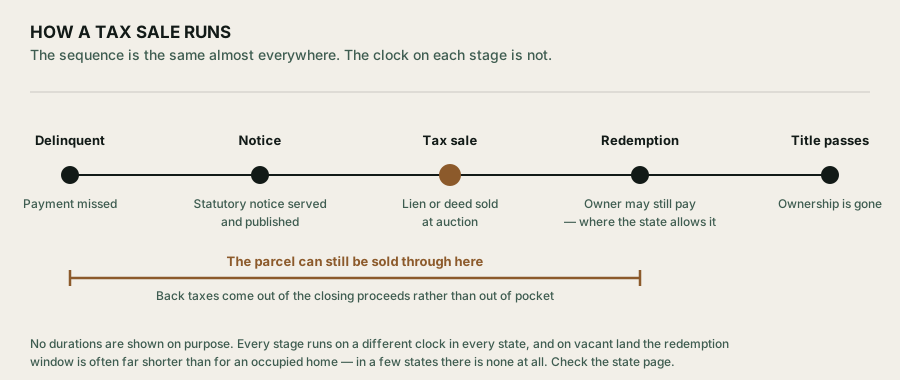
Some states use a tax deed system like Florida’s or Texas’s, where the county sells the property itself at auction. Others sell tax lien certificates instead, and the buyer only gets a deed later, after a separate foreclosure step if the delinquent owner never pays up. Still others mix elements of both. Which category your target county falls into changes almost everything about the process, so confirm it directly with the county treasurer, tax collector, or clerk of court before you assume either state’s rules above apply where you’re bidding.
Why Can’t You Get Title Insurance Right After You Win?
Because a tax deed transfers ownership through a government enforcement process rather than a voluntary sale by the record owner, title insurers generally won’t write a policy on it right away. A title insurance commitment “cannot be issued without the successful completion of a quiet title judicial action” in most cases, according to the American Land Title Association, which covers a legal proceeding that can stretch from months to years and may involve more than one lawsuit if prior lienholders contest it.
That gap matters more than it sounds. Without an insurable title commitment, you likely can’t get a mortgage lender to finance a resale, and many buyers won’t close without one either. Some underwriters will accept a due-diligence certification service as a shortcut around a full quiet title suit: ALTA’s own reporting cites turnaround times of 25 to 45 days for one such service, versus the months or years a court case can take. But accepting that shortcut is an underwriter-by-underwriter decision, not a guarantee, and it doesn’t apply everywhere. Budget for a title company or real estate attorney to review the tax sale’s chain of title and tell you, county by county, what it will actually take before you can insure and resell what you’re bidding on.
Because a tax deed conveys whatever interest the county actually had the legal power to transfer, and nothing more, it behaves in practice more like a quitclaim deed than a warranty deed: you get what the process produced, not a promise that it’s clean. That tradeoff is exactly why the due diligence below happens before you bid, not after.
What Due Diligence Should You Do Before You Bid?
Do your homework on the parcel’s liens, access, and occupancy before the auction, because once the gavel falls the sale is final and the county isn’t going to unwind it for you. Both Florida and Texas auction rules put this responsibility squarely on the bidder.
- Search the county land and tax records. Go back through the current owner’s chain of title for other recorded liens, judgments, or mortgages that might survive the tax sale in your state, not just the delinquent tax debt that triggered the auction.
- Check for a federal tax lien. If the IRS held a lien junior to the one being foreclosed and wasn’t given at least 25 days’ notice before a nonjudicial sale, the sale doesn’t disturb the federal lien, and it can survive against the property, per 26 CFR 301.7425-2. Separately, the IRS can redeem such property for up to 120 calendar days after the sale, according to the Internal Revenue Service’s own collection manual.
- Verify legal access. A legal access route to a public road matters more for vacant land than almost anything else. A landlocked parcel with no recorded easement can sell cheap at auction for exactly that reason.
- Pull the flood zone and wetland data. County GIS maps and FEMA flood maps are usually public and free, and they’ll tell you before you bid whether the buildable area you’re picturing is actually a wetland or flood zone.
- Check for occupants. Someone may still be living on or using the parcel. That affects both your timeline and, in a residential context, the process for regaining possession described below.
- Confirm the opening bid math. The advertised minimum often excludes taxes that accrued after the judgment, plus recording and documentary stamp costs that get added on top at closing.
- Walk the parcel if you can, or use aerial imagery if you can’t. Auction listings rarely include a current photo, and a legal description on paper won’t tell you about a dump site, an active timber cut, or a structure that isn’t on the tax roll.
- Line up certified funds in advance, sized to what you’re actually willing to lose on a deposit if you have to walk away rather than what you hope the winning bid will be.
What Happens After You Win: Deed, Possession, and Any Waiting Period?
Winning the bid gets you a deed, but what you can do with the land next depends on your state’s redemption rules and how the property is being used. In Florida, the tax deed grantee is entitled to immediate possession by statute. If a prior occupant won’t leave voluntarily, the buyer can apply to the circuit court for a writ of assistance “upon 5 days’ notice,” according to Florida Statutes Section 197.562, rather than filing a separate eviction lawsuit from scratch.
Texas works on a slower clock because of its post-sale redemption right. Under Texas Tax Code Section 34.21, a former owner can redeem non-homestead, non-agricultural, non-mineral property within 180 days of the deed being filed for record, and homestead, agricultural, or mineral property within two years, by repaying the buyer’s bid, recording fee, and costs plus a redemption premium of 25% in year one or 50% in year two. Practically, that means holding off on major spending, such as clearing, fencing, or permitting, on Texas land until the applicable window closes, since a redeeming owner takes the land back and only owes you money, not credit for your improvements.
Either way, plan for a stretch of time, sometimes months and sometimes years, between winning the bid and having a clean, insurable, freely marketable title. If you’re weighing a tax deed purchase against buying land the conventional way from an owner with clear title already in hand, our guide to buying land walks through what a standard purchase and due diligence period looks like by comparison, so you can see how much of that friction a tax deed purchase adds on top.
Occasionally a winning bidder discovers, after paying for a title search and running the redemption clock, that the parcel isn’t one they want to keep: the access problem is worse than advertised, the title cleanup costs more than expected, or back taxes on a related parcel complicate things further. If you end up in that position with vacant land you’d rather not carry, companies that buy land directly, including AMM Land Sales, take on parcels with back taxes or a cloud on title as part of an as-is purchase, whether the land came from a tax deed auction or anywhere else. Whichever state you’re bidding in, read the specific county’s published bidder rules before you register: Florida and Texas run their sales differently, and so does every other state, and the auction house’s own terms, not general guidance like this, control what happens if something goes wrong.