Texas gives a former owner 180 days to redeem property sold at a tax sale if it was non-homestead, non-agricultural land, which covers most vacant parcels. Homestead, agricultural-use, or mineral-interest property gets two years instead, with redemption costing more in the second year, under Texas Tax Code § 34.21.
That split sounds like a small technicality until you’re the one counting days, or the one who just won a parcel at a constable’s sale. Which track applies changes the deadline, the price of getting the land back, and how safe it is for a buyer to treat the deed as final. None of that is decided at the auction. It was decided earlier, when the lawsuit was filed, and neither the courthouse nor the constable is required to spell it out for you.
How long do you actually have to redeem land after a Texas tax sale?
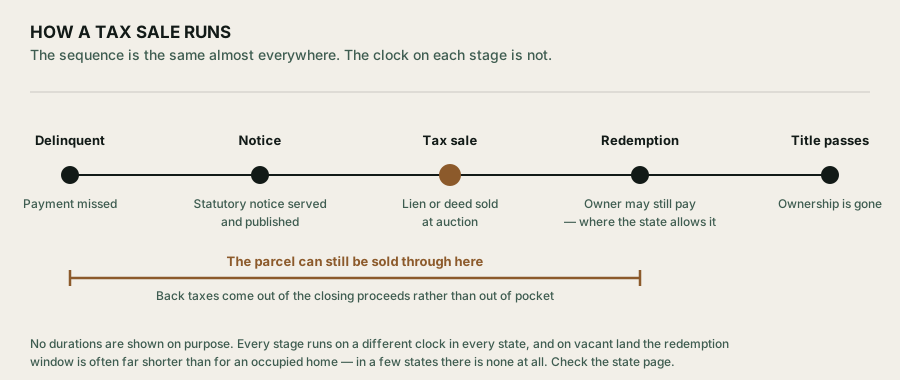
Most vacant land falls into the shorter track: 180 days from the date the purchaser’s deed is filed for record in the county where the property sits. Property that was used as the owner’s residence homestead, was appraised for agricultural use, or was a mineral interest at the relevant time gets a full two years from that same filing date instead, per Texas Tax Code § 34.21. Both clocks start running from deed recording, not from the auction date itself, and recording can lag the sale by weeks, so the actual deadline is a matter of county deed records rather than a date anyone announces at the sale. The sale itself only happens after taxes have been delinquent for a while: Texas property taxes become delinquent on February 1 of the year after they’re billed, according to the Texas Comptroller of Public Accounts, and the taxing unit’s lawsuit and eventual judgment come well after that date, not the redemption clock itself.
What actually determines whether a property gets 180 days or two years?
The classification is fixed at the moment the taxing unit filed suit or applied for the tax warrant, not at the time of the sale and not at the time someone tries to redeem. If the land carried a homestead exemption or an agricultural-use appraisal on record when that suit was filed, the two-year track and its higher premiums apply for the life of the redemption period, according to O’Connor & Associates’ summary of Chapter 34, Subchapter B. That timing rule cuts both ways. A parcel that lost its agricultural appraisal or had its homestead exemption removed between the filing date and the sale still carries the two-year period, because the law looks backward to the filing, not forward to the sale. A buyer who assumes a rural-looking lot is automatically 180-day property because it’s vacant and unimproved can be wrong if an agricultural appraisal was on file when the suit was filed years earlier, even if nobody has farmed the land since.
Why does Texas split the redemption period this way at all?
The split exists because Texas treats a homestead, a working farm or ranch, and a mineral interest differently from an ordinary investment parcel, and gives the first group more time and a steeper cost to walk away from. A residence homestead is where the owner actually lives; land appraised for agricultural use has generally been under an active farming, ranching, or wildlife-management appraisal with the county appraisal district, not simply zoned rural or left undeveloped; and a mineral interest is a severed ownership right in oil, gas, or other minerals under the surface, according to Texas Tax Code § 34.21 as summarized by O’Connor & Associates. Vacant land that’s simply unimproved and doesn’t carry an agricultural appraisal or a homestead exemption doesn’t get the benefit of that longer runway, no matter how rural it looks or how long the owner has held it. That’s the detail that catches out-of-state owners of raw acreage most often: they assume land in the country automatically qualifies as “agricultural,” when the statute is asking about a specific appraisal designation on file with the county, not the land’s character.
Why won’t the county just tell you which period applies?
Because the county’s role in the sale doesn’t require it to certify that fact, and several county offices say so directly. Sheriff’s and constable’s sales in Texas are run on a “buyer beware” basis, and Denton County’s own sale rules state plainly that the county “makes no representation as to which redemption period applies” to a given property, according to Denton County’s Sheriff’s Sale Rules. The deed a buyer receives is a sheriff’s or constable’s deed “without warranty, express or implied,” per the same source, and title insurance is often difficult or impossible to obtain until the applicable redemption period has fully run. That leaves the classification question to the buyer’s own homework: the county appraisal district’s records for the parcel’s exemption and appraisal history as of the suit’s filing date, and the court file itself, are the two places that actually answer the question a bidder needs answered before the gavel falls.
What does redeeming actually cost in each period?
The redeeming owner pays the purchaser back for everything spent on the property plus a premium, and that premium is where the two tracks diverge sharply.
| 180-day track (most vacant land) | Two-year track (homestead, agricultural, mineral) | |
|---|---|---|
| Redemption deadline | 180 days after deed is filed for record | 2 years after deed is filed for record |
| Premium if redeemed in year 1 | Up to 25% of the aggregate amount owed | 25% of the aggregate amount owed |
| Premium if redeemed in year 2 | Not applicable (window has closed) | 50% of the aggregate amount owed |
| What’s included in the amount owed | Purchase bid, deed recording fee, taxes/penalties/interest/costs the purchaser paid | Same |
| Statutory basis | Tax Code § 34.21(e) | Tax Code § 34.21(a) |
Sources: Texas Tax Code § 34.21, Texas Public Law’s text of § 34.21.
In practice, that means redeeming a homestead or agricultural parcel in month 13 costs double the premium it would have cost in month 11, according to Texas Tax Code § 34.21. A 180-day property owner never faces that jump because the entire window closes before a second-year premium could ever apply. Either way, the premium is calculated on the purchaser’s full outlay, not just the winning bid, so unpaid taxes, penalties, interest, and costs the purchaser covered after the sale all get added to the base before the percentage is applied.
The math changes again when a taxing unit itself is the purchaser rather than a private bidder. In that situation the redeeming owner pays the lesser of the amount of the judgment against the property or the property’s market value as stated in that judgment, plus filing fees and costs, rather than a bid-based premium, according to O’Connor & Associates’ summary of Chapter 34, Subchapter B. A former owner who can’t track down the private purchaser to pay them directly isn’t stuck: the statute lets them redeem through the county tax assessor-collector for the county where the sale happened, and that office issues a signed receipt as proof the property has been redeemed, per Texas Tax Code § 34.21.
What can’t happen while the redemption clock is running?
The redemption right gives the former owner a path back to the property, not the right to use it in the meantime. Texas Tax Code § 34.21 states that the right of redemption does not grant or reserve the former owner’s right to possession, rents, income, or other benefits of the property while that right is outstanding, per the statute’s text. A purchaser can generally pursue eviction, subject to protections for active-duty servicemembers and tenants under a bona fide lease. The redemption right also can’t be sold or signed over. The statute voids any instrument that purports to transfer it to someone else, meaning a former owner can’t cash out the right of redemption itself the way they might sell a claim to surplus proceeds.
What does the redemption period mean for someone buying at a Texas tax sale?
It means the deed you receive on sale day isn’t a finished transaction, and treating it like one is where investors lose money. Because the statute only guarantees reimbursement for costs tied to “maintaining, preserving, and safekeeping” the property, not for upgrades made in anticipation of a resale, an investor who fixes up or improves a parcel before the applicable redemption period expires risks losing that investment if the former owner redeems, according to LoneStarLandLaw.com. The safer approach is to hold the property and avoid substantial improvements or a resale until whichever period applies, 180 days or two years, has actually run its course, and to keep an itemized record of every dollar spent on the property in the meantime, since a redeeming owner can request a written accounting of those costs. Given that title insurers are often unwilling to write a policy until redemption has closed, a buyer’s practical exit options are limited during that window regardless of what the deed says.
Before bidding, a buyer’s realistic checklist looks less like reading the sale notice and more like building a mini title file:
- Pull the parcel’s appraisal and exemption history from the county appraisal district, focused on its status as of the date the taxing unit’s suit or warrant application was filed, not today.
- Read the underlying judgment or the court’s case file for the foreclosure suit, which will name the property and can show whether it was pursued as homestead, agricultural, or ordinary property.
- Confirm the deed’s recording date once it’s filed, since that date, not the auction date, is what starts either the 180-day or two-year clock, per Texas Tax Code § 34.21.
- Budget on the assumption that resale or major improvement isn’t realistic until the applicable period has run, and confirm with a title company in advance whether they’ll insure the parcel at all during that window.
None of that removes the redemption risk. It just means the buyer, not the county, is the one who has to find out which clock is running before money changes hands.
What should a Texas landowner do before either deadline hits?
Figure out which track applies before assuming the shorter or longer number is the one that governs, and act well before either deadline rather than near it. An owner who isn’t sure whether their land carried an agricultural appraisal or homestead exemption when the lawsuit was filed can pull that history from the county appraisal district and the court’s case file rather than guessing from how the land looks today. Redeeming means paying the purchaser (or the county assessor-collector, if the purchaser can’t be located) the full amount owed plus the applicable premium, and every day that passes inside a two-year window that crosses into its second year adds real cost. An owner who would rather not manage that deadline, or who is past the point of covering the balance, can also sell the parcel before a sale is ever scheduled. Back taxes are typically settled out of the closing proceeds rather than paid upfront, which is one option covered on AMM Land Sales’ page on selling land with back taxes. Selling ahead of the county’s timeline keeps the decision with the owner instead of a redemption clock.
For the broader mechanics of how a Texas tax sale gets to this point in the first place (the lawsuit, the judgment, and the auction itself), see our comparison of Florida vs. Texas tax deed sales. Anyone weighing options on Texas land specifically can also look at selling land in Texas and our broader guide to owning land, and review the redemption period and tax deed glossary entries for the terms used throughout Chapter 34.