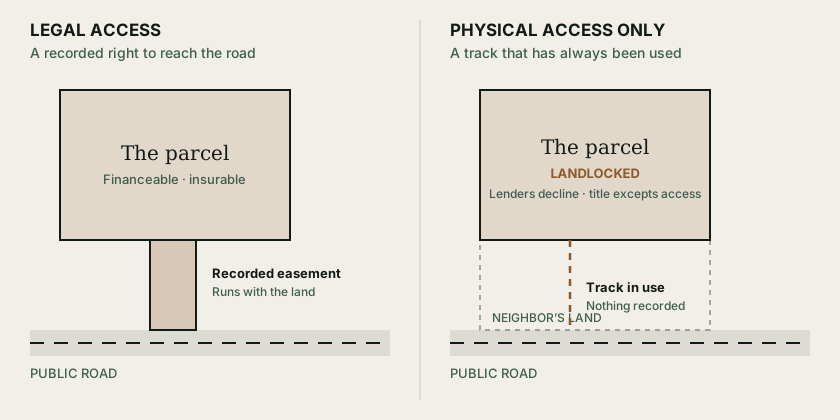
A landlocked parcel is not a discounted version of the same land with road access — it is a functionally different asset. Appraisal case work treats it as having no independent market of its own, valued mainly by what one adjoining landowner would pay, while a parcel with recorded access sells at the open per-acre market rate.
How do appraisers actually value a landlocked parcel?
Appraisers valuing a landlocked parcel don’t start from the area’s per-acre price and subtract a discount — they start by asking whether the parcel has a market at all. According to a July/August 2015 Right of Way magazine article by appraiser Tony Sevelka, MAI, land with no independent highest and best use and no legal access is termed a “non-viable remainder,” and its value isn’t drawn from comparable sales — it’s drawn from what it contributes to an adjoining property that could actually use it.
The article works through an appraisal example: a 0.15-acre strip left landlocked after a road-corridor taking sits next to an 81.40-acre parcel valued at $50,000 per acre. On a straight pro-rata basis, the landlocked strip’s maximum contributory value would be $7,500. But because only one buyer — the adjoining owner — has any reason to purchase it, the appraiser applies a further discount for trading in what he calls a “bilateral market,” cutting the contributory value to $3,750. That’s a landlocked sliver assessed at roughly half of even its already-reduced pro-rata share of the neighboring per-acre rate, not because the dirt is different, but because there is exactly one possible buyer and no open market to test the price against.
That single-buyer dynamic is the core mechanism behind every landlocked discount, whether the parcel is a leftover sliver from a road project or forty acres that was carved off a larger farm decades ago without an easement. The land itself hasn’t changed; what’s changed is who can legally use it and who would ever bid on it.
Why does missing legal access collapse the price so much?
Missing legal access collapses the price because it removes financing, insurability, and buildability all at once, not just curb appeal — and each of those losses compounds the others rather than adding up separately. According to the Western Landowners Alliance, “legal access is indispensable to marketable title to real estate,” and title commitments routinely carry an exception for access when a parcel has no recorded connection to a public road.
That exception cascades through the rest of the transaction:
| Consequence of no legal access | Why it happens |
|---|---|
| Title insurance won’t cover access | Insurers can’t underwrite a right that isn’t recorded, per the Western Landowners Alliance |
| Conventional financing is largely unavailable | Lenders can’t rely on unrecorded or permissive access as collateral security |
| No building permit in most counties | Many jurisdictions require proof of legal access before permitting construction |
| Buyer pool shrinks to almost one | Only owners of adjoining land, or cash buyers willing to gamble on an easement claim, will make an offer |
| Assessed value can be appealed down | Counties may adjust valuation once an access defect is documented, as Napa County does |
Napa County’s assessor page on landlocked parcels describes exactly that last row in practice: a buyer who discovers an access problem after closing can approach the assessor’s division and request a value adjustment that “reflect[s] an estimated cost to cure the access problem.” That’s a county government treating the access defect as something concrete enough to move the assessed number, not a vague discount applied by feel.
Can a landlocked owner just create legal access and recover the value?
Sometimes, but only if the legal path exists and the cost of securing it is worth what it recovers — and both of those conditions fail more often than owners expect. Courts recognize several routes to an easement by necessity or a statutory right-of-way, but each has narrow requirements that a convenient dirt path across a neighbor’s field doesn’t automatically satisfy.
According to the Center for Agricultural Law and Taxation at Iowa State University, a 2015 Iowa Court of Appeals decision confirmed that landlocked owners can pursue condemnation for an access road under Iowa Code, but the route “must be located on a division, subdivision, or ‘forty’ line, or immediately adjacent thereto,” and represent the nearest feasible connection to an existing public road — a court rejected a landowner’s preferred route in that case because it didn’t meet those geographic requirements, even though it was the most convenient option.
Texas took a different approach and wrote it into statute. Under Subchapter B, Chapter 251 of the Texas Transportation Code, a landlocked owner can petition a county commissioners court to declare a private road a public one, according to a Texas Real Estate Research Center publication from Texas A&M University. The affected neighbor is compensated through a “jury of view” process, and an owner who refuses to open the road within 12 months can face a fine — capped at $20 per month — if the landlocked tract runs 1,280 acres or more. That’s a real, quantified legal mechanism for forcing access, but it still requires a county proceeding, compensation to the servient owner, and months of process before the parcel is marketable again.
This is why the Right of Way magazine analysis frames a legal fix as a “cost-to-cure” question rather than an automatic remedy: the cure is only worth pursuing if what it costs to secure — negotiation, condemnation fees, road construction, the neighbor’s compensation — is less than the value the parcel gains once access exists. On raw acreage with a modest per-acre value, the math frequently doesn’t clear that bar, which is exactly why so much genuinely landlocked land stays landlocked and stays priced for a single buyer.
What does this mean if you’re trying to sell landlocked land?
If you’re trying to sell landlocked land, expect the buyer pool to be smaller and the process slower than for a comparable parcel with recorded access, because most conventional buyers and every mortgage lender are effectively excluded from the start. That’s consistent with what shows up in the assessor and appraisal sources above: your practical market is adjoining landowners, cash buyers comfortable underwriting an easement claim themselves, or a buyer willing to fund the cost-to-cure math before closing.
Sellers weighing whether to pursue an easement first or sell as-is are really answering the same question an appraiser asks about a non-viable remainder: does the value gained from fixing access exceed what it costs to fix it? AMM Land Sales looks at landlocked and access-limited parcels as part of its normal purchasing, factoring the access issue into its offer rather than requiring it be resolved before a contract can be signed — though sellers should still weigh that against pursuing a legal easement themselves if the underlying parcel value would clearly support the cost.
Before deciding, it’s worth pulling the parcel’s chain of title to check for prior common ownership with the adjoining tract — a prerequisite for an easement by necessity claim in most states — and confirming with the county assessor whether the access defect has already been reflected in the assessed value. Understanding the different types of easements that might already run with the property, or that a court could grant, shapes how strong that claim is before you spend money pursuing it.
The bottom line
Landlocked land and road-accessed land aren’t two points on the same pricing curve — they’re two different markets. One trades openly among ordinary buyers and lenders at the area’s per-acre rate; the other trades, if it trades at all, between a landlocked owner and the handful of adjoining owners who have any reason to bid, at a price appraisers derive from contributory value rather than comparable sales. Recorded legal access is what moves a parcel from the second market into the first, and until that happens, the size of the discount tracks how expensive and how legally uncertain the path to that access actually is.