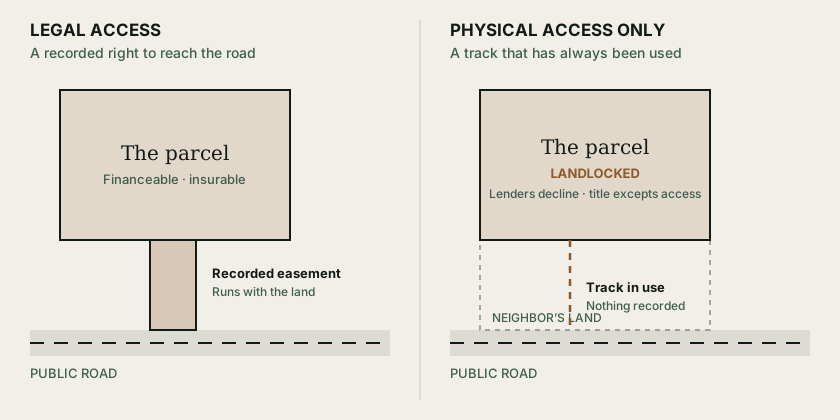
You can legally sell landlocked property without legal access, but your options and sale value will be limited. Most buyers and title companies require documented access. Without it, you may face steep discounts, legal hurdles, or an inability to close with title insurance. State law varies, but no state guarantees automatic access for private land.
Can you sell landlocked property without legal access?
You can sell landlocked property with no legal access, but it is difficult. Title companies are usually unwilling to insure such property, and many buyers will not close without title insurance, especially if they need financing. The process is legal, but the buyer takes on significant risk and value is typically much lower.
Title insurance is a major barrier. According to the Texas A&M AgriLife Extension, title companies are usually unwilling to insure landlocked property. Cash buyers may still close, but buyers needing a loan cannot, because lenders require title insurance. Even if a buyer is willing, they may demand a deep discount to compensate for risk and limited use. In Wisconsin, landlocked parcels may be sold, but valuation is tricky and buyers often make offers contingent on securing access (Wisconsin Real Estate Magazine).
If you own landlocked property, you can offer it for sale as-is, but expect a smaller pool of buyers, more negotiation, and possible legal review. Some specialized buyers and companies, including AMM Land Sales, will make cash offers for landlocked land, but only after verifying status and risk. For more details, review our selling problem land guide.
How do you find out if your land is landlocked or has a legal easement?
To find out if your land is landlocked, review your deed, the title report, and county records for any recorded access easements. If no public road or legal right-of-way appears, your land is likely landlocked. Consult a title company or attorney to confirm and interpret access rights.
A landlocked parcel is defined as land with no access to a public road or right-of-way (Napa County, CA). Deeds and title reports should show any easements or rights of way for ingress and egress. If you rely on a handshake agreement or unrecorded path, your access is not legally secure (Texas A&M AgriLife Extension).
If you are unsure, request a preliminary title report from a title company and ask if access is documented. In Wisconsin, buyers and sellers are advised to confirm access with a title company and legal counsel, especially if old agreements or informal arrangements exist (Wisconsin Real Estate Magazine).
Checklist: How to determine if your land is landlocked
| Step | What to look for | Source |
|---|---|---|
| Review your deed | Any mention of easements or right-of-way | Napa County, CA |
| Order a title report | Listed access easements or public road frontage | Texas A&M AgriLife Extension |
| Check county records | Recorded easements or road dedications | Wisconsin Real Estate Magazine |
| Inspect physical access | Is there a visible road or path? | Napa County, CA |
| Consult a title company or attorney | Professional review of your access status | Wisconsin Real Estate Magazine |
What options exist to get legal access to a landlocked parcel?
Options to get legal access include negotiating an express easement with a neighbor, proving an easement by necessity, prescriptive easement, easement by estoppel, or petitioning local government for a public road. The process, requirements, and success rates vary by state and by the facts of each property.
In Texas, five legal options exist: (1) obtain an express easement (a written, recorded agreement with a neighbor); (2) prove an easement by necessity in court; (3) prove a prescriptive easement (10 years of open, adverse use); (4) prove easement by estoppel (reliance on a neighbor’s representation); or (5) request a statutory easement from the commissioners’ court (Texas A&M AgriLife Extension).
In Wisconsin, landlocked owners can try to purchase additional land, negotiate a private road easement, or establish a prescriptive easement by 20 years of use without permission (Wisconsin Real Estate Magazine). If private efforts fail, a petition to the town under Wis. Stat. § 82.27 may be possible, but approval is discretionary and costs may fall on the owner.
In Iowa, a landlocked owner can seek condemnation for an access road under Iowa Code §6A.4(2), but the route must follow strict rules—adjacency to division lines or established routes—and compensation must be paid (Iowa State University Extension).
Whatever the option, legal counsel is recommended. Litigation is often lengthy and expensive, and success is not guaranteed.
How does being landlocked affect what your property is worth?
Landlocked property is worth much less than comparable land with legal access. The discount can be steep, and the property may be unsellable to buyers needing financing or title insurance. Actual value depends on the likelihood and cost of curing the access issue.
According to the Texas A&M AgriLife Extension, landlocked property is usually not accepted as collateral by lenders, and title companies often refuse to insure it. In Wisconsin, valuation is “tricky” and subject to negotiation or reduction for the cost and risk of obtaining access (Wisconsin Real Estate Magazine). In Napa County, CA, buyers are advised to consider the probable cost of curing the access problem, which can be substantial (Napa County, CA).
If you sell landlocked property, expect to negotiate with buyers who will factor in legal risk, lack of utility, and expense of litigation or negotiation. Some buyers will not consider such parcels at all. If you need to sell, see our guide to selling problem land for strategies and options.
What do state laws say about landlocked property rights?
State laws do not guarantee automatic access to landlocked property. Owners must rely on negotiation, litigation, or statutory procedures to obtain access, and outcomes vary by state and circumstance. Most states recognize some legal remedies, but these require proof and formal process.
In Texas, there is no automatic right to access landlocked property, and the common myth that neighbors must allow entry is false (Texas A&M AgriLife Extension). Legal options exist, but all require proof and often litigation. Statutory remedies, such as petitioning the commissioners’ court, are discretionary.
In Wisconsin, landlocked owners may petition the town board to build a public road, but the board may deny the request if not in the public interest. The owner is responsible for significant costs if successful (Wisconsin Real Estate Magazine).
In Iowa, condemnation is possible under Iowa Code §6A.4(2), but the route must follow specific property lines and just compensation must be paid. The court may deny access if requirements are not met (Iowa State University Extension).
Federal law, such as the Unlawful Inclosures Act, focuses on public land and does not provide private landowners with a clear right of access across private property (Lewis & Clark Law School).
Summary Table: Legal Options for Landlocked Property Access
| Option | States/Examples | Notes |
|---|---|---|
| Express easement | TX, WI, CA | Negotiated, written, recorded; may require payment |
| Easement by necessity | TX, CA, WI | Requires proof of necessity and court action |
| Prescriptive easement | TX (10 yrs), WI (20), CA (5) | Requires open, adverse use for statutory period; court action needed |
| Easement by estoppel | TX | Based on reliance on neighbor’s representation; must be proven in court |
| Statutory/public road petition | TX (commissioners’ court), WI (town board), IA (condemnation) | Discretionary; may involve costs and strict rules |