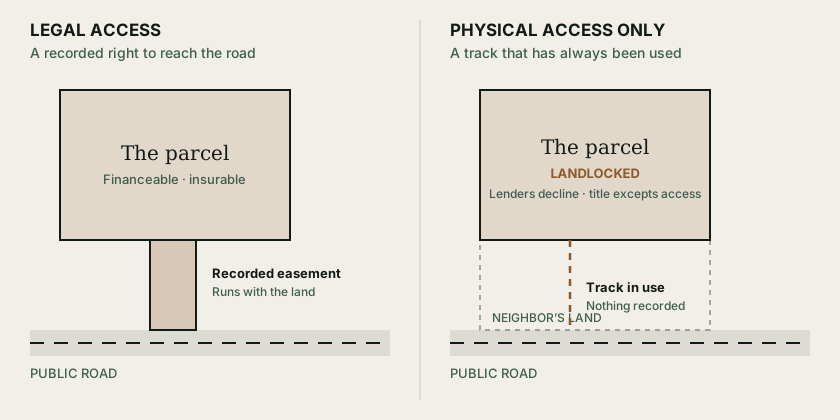
An easement by necessity is a court-recognized right to cross a neighbor’s land, available only when your parcel and theirs were once one property under the same owner and the split cut off road access. Proving unity of title, severance, and necessity, then recording the result, is the core pre-sale strategy for fixing access before listing.
What Are the Elements of an Easement by Necessity?
Every version of this doctrine rests on the same three building blocks, and missing any one of them defeats the claim regardless of how badly the parcel actually needs access today. According to the Cornell Law School Legal Information Institute, an implied easement by necessity requires unity of ownership — both parcels formerly held as a single tract — and necessity that arose at the moment of severance, not afterward. Florida’s version, worked through in detail by Derrevere Stevens Black & Cozad, breaks the common-law claim into three specific proofs: that both properties were once owned by the same party, that the common grantor conveyed the landlocked parcel away, and that at the time of that conveyance the grantor’s remaining land still had access to a public road. Lose any one of the three and the claim fails.
| Element | What you have to prove | Where it comes from |
|---|---|---|
| Unity of title | The landlocked parcel and the surrounding tract were once owned by the same person or entity | Deed history, chain of title |
| Severance | That common ownership was divided by sale, gift, or devise | The deed that split the tract |
| Necessity at severance | Access was cut off at the moment of the split, not created later by a neighbor building a fence | Deeds, plats, and surveys from around the severance date |
The evidence for all three lives in old deeds, plats, and probate or estate records, which is why a title search — not a walk of the property line — is where this claim actually gets built.
Courts also split on how strictly “necessity” has to be shown, and which standard applies can decide the case. Per the Cornell Law School Legal Information Institute, the traditional “strict necessity” standard requires the landlocked owner to show absolute isolation — no legal access alternative of any kind, including an existing easement or a mere license from another neighbor. A minority of jurisdictions instead apply “reasonable necessity,” which asks only whether there is no other practical way to enjoy the property, a standard that can extend to utility access as well as vehicle access. There is also a hard stop that defeats the claim regardless of the standard used: if the deed that severed the parcels expressly stated the new owner would not have a right-of-way across the grantor’s remaining land, no implied easement by necessity arises, no matter how landlocked the parcel later became.
What Evidence Do You Actually Need to Gather?
Proving unity of title and severance means reconstructing the chain of title back to the point the tract was one parcel, and that record is usually sitting in the county recorder’s office rather than anywhere on the land itself. A seller building this case typically needs the older deeds showing common ownership, the specific conveyance that split the tract, any plat or survey recorded around the time of that split, and — where the severance happened through inheritance rather than sale — probate records identifying how the estate divided the land among heirs. A title company or a real estate attorney doing a full title search can usually assemble this packet faster than an owner working county records alone, and the same packet becomes the evidentiary basis for the court filing if litigation turns out to be necessary.
How Does a Statutory Way of Necessity Differ From the Common-Law Claim?
Florida recognizes both an implied common-law way of necessity and a separate statutory way of necessity, and the statutory version exists precisely because unity of title is not always provable. Under Florida Statutes § 704.01, the common-law rule “is hereby recognized, specifically adopted, and clarified,” and a right-of-way is presumed to have been granted or reserved wherever a person conveyed or retained land that has no accessible right-of-way except over land the same person once held. Section 704.01(2) goes further and creates a statutory right that does not depend on any shared ownership history at all: it applies when land used or intended for a dwelling, agriculture, timber, or stockraising is “shut off or hemmed in by lands, fencing, or other improvements” with no practicable route to the nearest public or private road. As Derrevere Stevens Black & Cozad lays out, the statutory route requires several things the common-law claim doesn’t: that the property is landlocked, that no practicable route exists, that no unity of title applies, that it’s used or intended for one of the statute’s listed purposes, and that the requested route is the nearest practicable one. An older version of the statute also required the parcel to sit outside a municipality, but that limit no longer applies under the current statute.
| Common-law way of necessity | Statutory way of necessity | |
|---|---|---|
| Requires unity of title | Yes | No |
| Limited to certain land uses | No | Yes — dwelling, agricultural, timber, or stockraising |
| Route standard | Reasonably necessary | Nearest practicable route |
| Governing law | Common law, codified at § 704.01(1) | § 704.01(2) |
Both routes ultimately produce the same practical outcome — a recordable right-of-way — but an owner who cannot prove common ownership with the neighboring parcel isn’t automatically out of options if the property otherwise qualifies under the statute.
Why Establish the Easement Before You List, Instead of Letting a Buyer Deal With It?
An unrecorded claim to an easement by necessity is not a permanent safety net, and a title search during a sale is exactly where that becomes a problem. In H & F Land, Inc. v. Panama City-Bay County Airport and Industrial District, 736 So. 2d 1167 (Fla. 1999) — confirmed by Lawpipe’s case summary — the Florida Supreme Court held that Florida’s Marketable Record Title Act extinguishes a common-law way of necessity if the owner does not file notice of the claim within 30 years of the root of title, even where the underlying facts would otherwise support it. That case turned on a landlocked parcel whose predecessors never recorded their claim, and the court found the right gone as a matter of law even though the parties agreed the easement had genuinely existed since 1940. A seller who waits until a buyer’s title company flags the access problem is negotiating from a weaker position than one who already holds a recorded, court-confirmed easement: the parcel shows as landlocked with an unresolved title defect instead of as a parcel with documented legal access, and that difference shows up in every offer that comes in.
What Does the Legal Process Actually Involve?
Getting an easement by necessity established almost always means filing suit, because a neighboring owner has little incentive to sign away part of their property voluntarily. Under Florida Statutes § 704.04, when the owner of the land being crossed objects or won’t permit use of the way until compensated, either party may file suit in circuit court to determine whether the claim exists and what compensation is owed. The court decides the type, duration, extent, and location of the easement, along with the compensation amount, and either side can request a jury trial on the compensation question in their original pleadings. Critically, the easement itself does not take effect until the award is paid — “the easement shall date from the time the award is paid,” per the statute — so an owner planning around a sale needs to budget for both the litigation timeline and the payment to the servient landowner before the access right is final. According to the Florida Litigation Guide, the route itself has to follow “the nearest practical route, considering the use to which said lands are being put,” which means the owner doesn’t get to pick the most convenient path — only the shortest reasonable one. The statute also lets the court award attorney’s fees and costs against whichever side acted unreasonably in refusing to comply, according to Florida Statutes § 704.04, which gives both the landlocked owner and the neighboring owner a reason to negotiate a recorded easement voluntarily rather than let a judge decide the terms.
What If You Don’t Have Time to Litigate Before You Sell?
Establishing an easement by necessity through the courts can take months, and a seller working against a closing deadline may not have that kind of time to spare before listing. An owner facing a deadline — an estate that needs to close, a tax obligation, a job relocation — has to weigh the cost of delay against the value an established easement adds to the listing. There is also a middle path short of a full lawsuit: many landlocked-access disputes settle once the neighboring owner is presented with the deed history and understands a court will likely rule the easement into existence anyway, since a negotiated, recorded easement avoids both sides paying for litigation and the compensation amount can usually be agreed rather than left to a jury. Disclosing the landlocked status honestly and selling as-is to a buyer prepared to pursue the same claim is another option; a company that buys landlocked land for cash without requiring resolved access first is a third, particularly when the deed history is thin enough that proving unity of title would itself take significant research. Either way, the underlying facts don’t change based on who ends up owning the parcel — the same three elements either support a claim or they don’t, and a seller who has already pulled the deed history knows which situation they’re in before a buyer’s attorney does.
Whichever path an owner takes, the paper trail matters more than the parcel’s current condition. A recorded easement or a documented, litigated easement by necessity converts a landlocked parcel into one with confirmed legal access, and that conversion is worth doing the research for even if the owner ultimately decides not to finish the court case themselves. For sellers working through access problems in Florida specifically, the deed records that prove or disprove unity of title are held at the county recorder’s office where the original tract was platted, and pulling them is the first real step — long before any court filing.
For a broader look at how other access and title problems affect a sale, see the selling problem land guide.