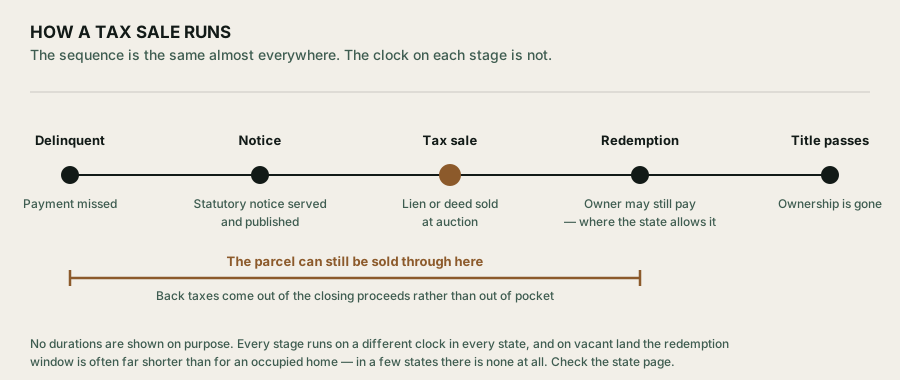
Most counties begin the foreclosure process and can take your land after property taxes go unpaid for 2 to 3 years, though some counties may wait up to 5 years. The exact timeline and process depend on your state and sometimes your county, and some states give owner-occupied property a longer redemption window than other land.
How long can you go without paying property taxes in each state?
You can go without paying property taxes for 2 to 5 years before your land is subject to foreclosure, depending on the state and county. In Michigan, the timeline is around 2 years; in California, it can be up to 5 years. The specific process and deadlines vary by jurisdiction.
The table below summarizes timelines from states where public sources confirm the rules for tax delinquency and foreclosure:
| State | Years Before Foreclosure Starts | Key Details & Source |
|---|---|---|
| Michigan | 2-3 years | Forfeiture after 1 year, foreclosure after about 2-3 years (Genesee County, MSU Extension) |
| California | 5 years | Sale after 5 years of unpaid taxes (San Luis Obispo County) |
| Ohio | Varies, typically 2-3 years | Auditor’s sale and forfeiture process (Franklin County) |
| Illinois | 3 years for most property; 1 year vacant non-farm | Runs from the date of the tax sale, not from delinquency (Peoria County) |
Michigan reduced its timeline from approximately 5 years to about 2 years under a 1999 law (Wayne County). In California, counties may wait five years before auctioning tax-defaulted land (San Luis Obispo County). In Ohio, the timeline varies, but forfeiture and sale are handled under rules set out by each county auditor (Franklin County).
If you are an absentee landowner, check directly with your county treasurer or auditor. The process and deadlines can differ even within a state. If you own land in another state, see our guides to selling land by state.
What affects the timeline for losing land to tax foreclosure?
The main factors that affect how long you can go without paying property taxes before losing your land are state law, county policy, and the type of property you own. Some counties are strict and move quickly, while others may give more time or allow payment plans. Vacant land is often at higher risk because counties have less incentive to delay foreclosure when there is no occupied home involved.
A county may also move faster if the property is already tax delinquent from prior years, if there are code violations, or if the land is in a redevelopment area. If you have received multiple notices or warnings, your property is likely already in the early stages of the process.
What starts the foreclosure clock on vacant land?
The foreclosure clock starts when property taxes go unpaid past the due date, and the property becomes delinquent. Most counties mark the start of the clock as the date taxes become delinquent, not when the bill is first missed.
For example, in Michigan, property is forfeited to the county treasurer after one year of delinquency (Genesee County). After another year in forfeiture, it enters foreclosure. California counties generally begin counting from the date taxes first become delinquent, but the property is not eligible for sale until five years have passed without payment (San Luis Obispo County).
Vacant land does not always get a longer grace period. Where a difference exists it is usually written into the redemption period for owner-occupied property, not into how quickly a county acts. Notice requirements themselves do not relax: under Mennonite Board of Missions v. Adams (1983) and Jones v. Flowers (2006), a government taking property for unpaid taxes must give notice reasonably calculated to reach the owner, and must take further reasonable steps when it learns the notice was not delivered.
Typical steps in the tax foreclosure timeline
- Tax bill issued – County sends annual property tax bill to the address on file.
- Delinquency – If not paid by the due date, the tax becomes delinquent and penalties begin to accrue.
- Notice of delinquency – County sends notices to the owner’s last known address. Some counties also publish notices in local newspapers.
- Forfeiture or certificate sale – After a set period (often 1 year), the property is forfeited to the county or a tax lien certificate is sold.
- Redemption period – The owner may have a window to pay off taxes, penalties, and interest to reclaim the property.
- Foreclosure and auction – If taxes remain unpaid, the county forecloses and sells the property at public auction.
Each step has its own deadlines and requirements, and those deadlines are set by statute rather than by whether anyone lives on the parcel.
Does the process work differently for vacant land and homes?
Yes, the tax foreclosure process can work differently for vacant land and homes. Vacant land often moves more quickly through the process because there are fewer protections for owners who do not occupy the property.
For example, in Illinois, most property carries three years to redeem — extended from two and a half by an amendment effective July 2026 — running from the date of the tax sale rather than from the day the taxes became delinquent — so the total elapsed time from first delinquency is longer. Vacant non-farm land gets a shorter window of one year from that same date (Peoria County). This protection does not always extend to vacant land or absentee owners. In Michigan the statutory process is the same for all property types (Genesee County).
If you are out of state, keep your mailing address updated with the county. Missed notices are a common reason absentee owners lose land to tax foreclosure.
For more on how to handle problem parcels, see our guide to selling land with back taxes.
Why do absentee owners lose land more often?
Absentee owners lose land more often because notices go to an address the county has on file, and that address is frequently years out of date. The law is on your side here: a county must send notice reasonably calculated to reach you, and under Jones v. Flowers it must take additional reasonable steps if that notice comes back undelivered. What it cannot do is find you at an address you never updated. Filing a change of address with the county treasurer is the single cheapest protection available to an out-of-state landowner.
Can you get your land back after a tax sale?
Usually, you cannot get your land back after a tax foreclosure and sale. In Michigan, for example, foreclosure is final and you lose all rights to the property after the deadline passes (Genesee County).
In Ohio, there is a limited right of redemption after the sale, but only under specific circumstances (Franklin County). If a parcel sells for less than the court’s finding plus costs, and the original owner still owns it within three years after the sale, the auditor may add the difference to the taxes due (Franklin County).
If your land has already been foreclosed and sold, contact the county office immediately for information on any remaining rights. In most cases, waiting until after foreclosure means you cannot reclaim the property.
For options before the deadline, you can sell the land, pay the taxes in full, or sometimes arrange a payment plan. AMM Land Sales makes cash offers on land with back taxes in all 50 states. Learn more in our FAQ.
What are your options before foreclosure is final?
- Pay the taxes in full – This stops the foreclosure process and restores your ownership rights.
- Set up a payment plan – Some counties allow payment plans if you act before the final deadline.
- Sell the land – You can sell the property before foreclosure. The buyer will pay off the taxes at closing.
- Do nothing – If you take no action, the county will eventually foreclose and sell the land.
If you are considering selling, AMM Land Sales contracts to purchase land in all 50 states, including parcels with back taxes. There is no commission or fee to the seller, and closing costs are paid by AMM Land Sales. For more on the process, see how it works.
What state or county office runs the tax foreclosure process?
The county treasurer or auditor typically runs the tax foreclosure process. This office is responsible for collecting property taxes, sending notices, conducting forfeiture, and overseeing the auction or sale.
In Michigan, the county treasurer handles forfeiture and foreclosure (Wayne County). In Ohio, the county auditor manages the process and the sale of forfeited lands (Franklin County). In California, the county tax collector and auditor-controller coordinate the auction of tax-defaulted property (San Luis Obispo County).
If you are unsure which office to contact, start with the county treasurer. They can direct you to the correct department and provide details on your property’s status. For a step-by-step look at the process, visit our guide on how it works.
What documents and notices should you expect?
- Tax bill – Sent annually to the address on file.
- Notice of delinquency – Sent after the due date passes with no payment.
- Notice of forfeiture or certificate sale – Sent if taxes remain unpaid after the first year (timing varies).
- Notice of foreclosure – Sent before the property is auctioned or sold.
- Notice of sale – Details about the public auction or sale process.
If you do not receive these notices, check with the county to confirm your address is current. Many counties also post notices online or in local newspapers.
What happens to unpaid property taxes at closing if you sell?
If you sell your land before foreclosure, unpaid property taxes are paid out of the closing proceeds. The title company handling the closing will ensure all delinquent taxes, penalties, and interest are paid before the deed transfers to the buyer. This is standard practice in every state. You do not need to pay the taxes in advance; the amount owed is subtracted from your proceeds at closing.
AMM Land Sales pays closing costs and settles delinquent property taxes from the closing proceeds. There is no commission or fee to the seller. Every purchase closes through a licensed title company. For more details about selling land with back taxes, see our guide.
What if you inherited land with unpaid property taxes?
If you inherited land with unpaid property taxes, you are responsible for the taxes as the new owner. The foreclosure timeline does not reset when ownership changes. If the property is already delinquent, you must act quickly to prevent foreclosure. You can pay the taxes, set up a payment plan, or sell the land before the deadline. For more on inherited land, see our guide to selling inherited land.
Summary table: Key facts about property tax foreclosure on vacant land
| Question | Typical Answer |
|---|---|
| Years before foreclosure starts | 2-5 years, varies by state and county |
| Who runs the process? | County treasurer, auditor, or tax collector |
| Does vacant land move faster? | Often yes, especially if owner is out of state |
| Can you get land back after tax sale? | Rarely; most states make foreclosure final |
| What happens to unpaid taxes at closing? | Paid from closing proceeds by title company |
| Can you sell land with back taxes? | Yes, before foreclosure is final |
If you own vacant land with unpaid taxes, act before the foreclosure deadline. For more information on your options, see our blog or contact us for a no-obligation offer.