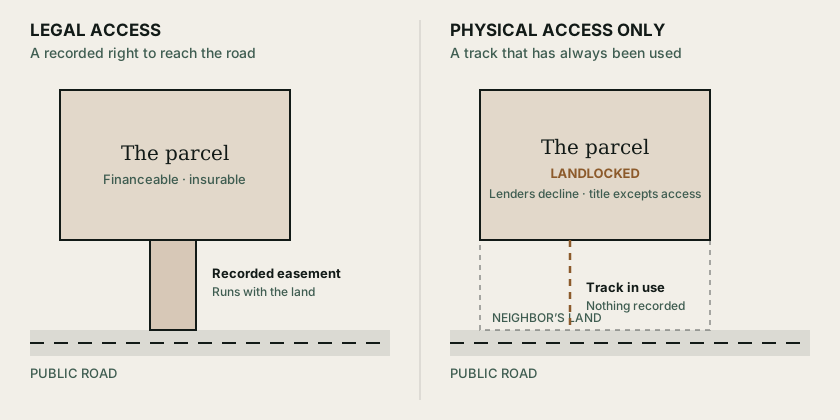
Verify legal access from records, not from the road. Confirm who owns the parcel and pull its legal description. Then check for frontage on a road the county or state maintains, an express recorded easement, or a dedicated right-of-way on the plat. Order a title commitment and read the exceptions. A two-track you drove during a showing proves nothing.
How do you verify legal access to vacant land before you buy?
Work from the cheapest records to the most expensive. Identify the parcel, confirm the road’s legal status, and search the recorded easements and plats. Then order a title commitment and a survey. Legal access is a recorded right that benefits your specific parcel. A road you can see, map, or drive on proves nothing until the records back it up.
The physical road is the trap. According to Colorado Ranch & Land, being able to drive to a property does not mean you have the legal right to. A road that appears on a map is not necessarily publicly maintained, and one that looks public may be privately owned. Buying and Selling Land makes the same point: looking at a road cannot tell you whether it is official or whether a recorded easement exists.
The reverse also holds. Colorado Ranch & Land notes that a road shown on a plat may never have been built. It also notes that the corridor in the recorded documents may not match where people actually drive. Access by Forest Service permit or another license is not the same as a deeded easement. It may expire, need renewal, or carry transfer limits, so verify it directly with the issuing agency.
| Record | Where it comes from | What it can prove | What it cannot prove |
|---|---|---|---|
| Road status | County or state road authority | Whether the road is publicly maintained | Whether your parcel touches it, or how wide the right-of-way is |
| Recorded easement | County recorder | A grant of ingress and egress, with its width and permitted uses | Where the traveled road actually sits |
| Plat and declarations | County recorder | Dedicated rights-of-way, and access rights created in covenants | Whether a platted road was ever built |
| Title commitment | Title company | Whether the insurer excepts lack of access | Physical usability or permit suitability |
| Survey | Licensed surveyor | Where the road sits relative to the recorded corridor | Rights that were never recorded |
| Permit or license | Issuing agency | Current authorization to cross | Permanence or transferability |
Colorado Ranch & Land advises handing the surveyor every recorded document you found, so the survey ties the paper to the ground. This follows the same due diligence order the site recommends for any parcel. Each step should be able to kill the deal before you spend money on the next one.
How do I find out who owns the land and get its full legal description?
Start with the county. The assessor’s record gives you the parcel number (APN) and the owner of record. The recorded deed gives you the legal description. Check that the two match. Every access question after that depends on the legal description, because an easement only helps if it benefits the exact parcel you are buying.
According to Buying and Selling Land, the official plat map shows neighboring parcel numbers. Free GIS systems may also show owner names and mailing addresses, though not phone numbers or email. Use the APN to pull the most recent deed from the county recorder. Read the legal description in full rather than relying on the shorthand printed on the tax bill.
Next, confirm that the person selling you the land is the person on the deed. If the names do not match, or the owner of record has died, stop and find out why before you go further. An unprobated estate or a broken chain of title is a legal problem, not a physical one, and legal problems are the ones that end deals.
The legal description is also what you compare against every easement you find. Colorado Ranch & Land lists “confirm the access rights benefit the parcel being purchased” as its own due diligence step. An easement might have been granted to a neighboring lot, or to a larger tract that was later divided. Whether it carries over to your piece is a question for a title examiner or an attorney.
While you are in the records, write down the adjoining owners. If access turns out to be missing, they are the people who could grant it. Per Buying and Selling Land, title records show their names and mailing addresses but not their phone numbers. A Realtor can look them up by address or APN, and skip-tracing services exist if those routes fail. The same source adds a caution: a buyer who is not yet in escrow has no authority to negotiate an easement. Keep early contact to fact-finding.
What does a title commitment show about access, and what does Schedule B leave out?
A title commitment tells you what the insurer will and will not cover, and access shows up in Schedule B, the exceptions. If the commitment excepts “the lack of right of access to and from the land,” the insurer will not stand behind access, and the parcel is usually landlocked. Schedule B does not tell you whether any road is usable.
Buying and Selling Land calls the title report the easiest way to find out whether a parcel is landlocked. If the title company insures title but not access, that exception appears. If it insures both, the exception is absent and you can be fairly sure legal access exists. Exception wording can differ between title companies, so read whatever access language your commitment contains. Do not just search it for one exact sentence.
Read every other exception too. Schedule B lists the recorded easements that burden your parcel, and it often references documents that create rights in your favor. Pull each one. Colorado Ranch & Land says to check each easement’s location, width, permitted uses, maintenance obligations and restrictions. It also warns that a pedestrian easement should not be assumed to allow vehicles.
What the commitment leaves out matters as much as what it shows:
- Permit width. It does not tell you whether the recorded route is wide enough for a building permit. Buying and Selling Land notes that the city or county permit requirement sets that width.
- Subdivision width. National Land notes that some counties require a minimum right-of-way width before a parcel can be subdivided.
- Road maintenance. It does not tell you who maintains a private road or how the costs are split.
Long use is not a substitute for a record. National Land describes a seller who had lived in a home on her land for 30 years. Title work then found no recorded right of way through five neighbors, and the sale fell apart. When access is in doubt, the same source advises an attorney’s title review, with a survey to clear up confusion.
Does title insurance cover access, and what does an ALTA access endorsement add?
An owner’s policy covers access only if the insurer did not except it. When Schedule B excludes lack of access, the policy says nothing about whether you can reach your land. An access endorsement can add coverage. Its scope depends on its wording and the underwriter, so read the endorsement itself before treating it as proof.
On rural land, the exceptions decide what the policy is worth.
The top search result offers one heuristic: if the title company will insure access, you probably have it. That matches Buying and Selling Land, which says that when the insurer covers both title and access, you can be fairly sure of legal access. It is a good test. It is not the whole answer.
Insuring a right of access is not the same as insuring a usable road. According to Colorado Ranch & Land, a recorded easement may establish the right of access without settling the exact location or scope of the road you drive. A platted road may never have been built at all. A title policy can be clean on access while the route is still a creek crossing and a stand of timber.
Endorsements are separate forms added to a policy, and availability and wording vary. Ask the title company, in writing, whether it will issue an access endorsement on this parcel. Get a copy of the form and read what it insures and what it excludes. If the title company declines to offer one, treat the refusal as information about the parcel.
You may already own the land and be unsure what you have. In that case, National Land suggests starting with the attorney or title company that handled your purchase. They may be able to find the original title commitment file or your existing policy. That file will show how access was treated when you bought.
Will a bank or Farm Credit lender finance land without recorded legal access?
Expect it to be difficult. According to Colorado Ranch & Land, unresolved access affects financing as well as value, marketability and title insurance. Raw land is already weak collateral, and a parcel the title company will not insure for access is weaker still. Each lender sets its own rules, so ask before you apply.
Our sources do not publish any specific bank’s or Farm Credit association’s access policy, and this article will not guess at one. What is predictable is the mechanism. A loan against land is a loan against what the lender could sell if you stop paying. If no buyer can legally reach the parcel, the lender inherits the same problem you would. Lenders also differ in how they set land loan terms generally, so it is worth asking more than one.
Practical steps before you commit:
- Send the lender the title commitment early. Ask, in writing, whether the access it shows, or the access exception, meets the lender’s underwriting requirements.
- Ask whether the lender requires an access endorsement on its own policy.
- Ask whether a recorded easement signed before closing would satisfy the lender, and what form that easement must take.
Timing is the usual conflict. According to Buying and Selling Land, sellers typically want to close in 21 to 45 days, while creating an easement can take months or a year or more. The same source puts rough odds on how sellers respond:
- Per Buying and Selling Land, sellers entertain an easement contingency about 2% of the time.
- By the same Buying and Selling Land estimate, they create the easement before closing about 1% of the time, usually when they own the adjacent parcel or the neighbor is family or a friend.
- About 97% of the time, according to Buying and Selling Land, buyers take the land as is and pursue the easement after closing.
Those percentages are one land investor’s estimates, not survey data. They still explain the bind. A lender usually wants access settled before closing, and a seller rarely waits long enough for that to happen. If you need financing, make verified access a condition you can test before you are bound.
Is landlocked property worth anything, and can you sell it in North Carolina?
Yes on both counts, with caveats. Landlocked land sells, usually for far less than the same land with access. Nothing in our North Carolina sources prohibits selling it. The state Real Estate Commission’s guidance on latent defects is a reason to disclose access problems plainly. North Carolina access law itself is a question for a North Carolina attorney.
On value, Buying and Selling Land describes a comparable parcel priced at $20,000 landlocked, against $200,000 if access existed. That is one example, not a rule, but the direction holds: missing access gets priced in.
On North Carolina, here is what the sources actually say. The February 2025 NCREC bulletin does not address how to verify legal access. It does say North Carolina sellers may be liable for knowingly withholding or misrepresenting material latent defects. Liability requires proof that the seller actually knew of the defect and intentionally misrepresented it or failed to disclose it. The bulletin also notes that brokers rely on seller disclosures because latent defects are hidden. Whether missing access counts as a latent defect in a particular sale is a legal question. The safe course is to state what you know.
Ways access can be established, in general terms:
- Express easement. Negotiate a recorded right to cross a neighbor’s land, possibly for compensation, per JustAnswer.
- Necessity. This may apply when the land is entirely surrounded and cannot be used without access. It typically requires showing the parcel was once part of a larger tract that had access, and it often takes negotiation or litigation, per JustAnswer.
- Prescription. This rests on long use without the owner’s objection. Per JustAnswer, the required period in many jurisdictions ranges from 5 to 20 years. Colorado Ranch & Land puts Colorado’s at 18 years and notes that permission from the owner undermines the claim. North Carolina’s period is not in our sources.
Buying and Selling Land warns not to expect the seller, county, broker, title company or neighbor to create the easement for you. Each theory needs documents and facts behind it, so bring in a real estate attorney.
What are your options if you own land with no legal access?
You have several realistic routes. None is free, and they trade time against certainty.
- List it. Expect months on the market and a commission.
- Auction it. An auction sets a date, not a price.
- Hold it and fix access. You can negotiate an easement or pursue a claim in court. Creating an easement by negotiating with a neighbor can take months or a year or more, per Buying and Selling Land. Attorney and survey costs add up, and property taxes keep coming.
- Offer it to a neighbor. An adjoining owner may be the one buyer for whom access does not matter. It is worth a letter.
- Sell directly. You get a specific offer and a set closing date, with the access problem left as it is.
AMM Land Sales makes offers on landlocked parcels directly to owners in every state and takes the land on as it stands, missing access and back taxes included. There is no commission and no fee to you. AMM pays closing costs, and any delinquent taxes are settled from the closing proceeds. Call (815) 384-6153, or get a cash offer for your landlocked parcel.